With delivery companies increasingly using cargo bikes to make deliveries faster and more efficient, the new rule could open the door to a ‘delivery revolution.’


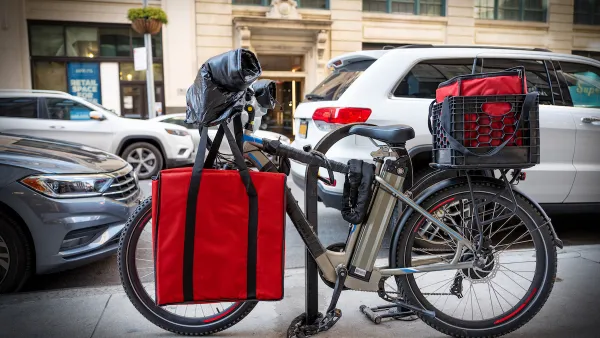
New York City’s Department of Transportation is on track to approve a new rule allowing four-wheeled cargo bikes up to 48 inches wide to operate on the city’s streets, report Gersh Kuntzman in Streetsblog NYC. This move could revolutionize urban deliveries and reduce the need for large trucks, particularly in dense urban areas like New York.
“The DOT itself has highlighted the potential of cargo bikes by using an electric-assist four-wheeler — anointed "Cargi B" in a much-questioned Twitter poll — to ferry equipment around various job sites in Manhattan and to demonstrate to reporters.” According to DOT Commissioner Ydanis Rodriguez, “Just two cargo bikes can replace one box truck, increasing safety and reducing CO2 emission by 14 tons per year—equivalent to 30,872 passenger car miles traveled.”
The city has a stated goal of supporting the deployment of over 2,000 cargo bikes by 2026, Kuntzman adds. “The rule change would only allow for pedal-assist bikes, with e-bike technology similar to Citi Bike’s popular electric models.”
Read the full story: City Moves to Allow Wider Cargo Bikes; Is a Delivery Revolution Next?


Cargo Bike Industry Pushes Back on NYC Rules
Cargo bike producers and delivery companies say the proposed 120-inch length limit and emphasis on four-wheeled bikes excludes many commonly used delivery bikes and favors one manufacturer.
New York Launches Nation’s First Micromobility Trade-In Program
The program addresses safety concerns about e-bikes and e-scooters by letting residents trade in non-UL compliant devices.
Street Fighting Woman: New Book by Janette Sadik-Khan Details Time at NYC DOT
The media response to Janette Sadik-Khan's new book has been at scale with the New York-sized ambitions of her tenure as commissioner of transportation.

Planetizen Federal Action Tracker
A weekly monitor of how Trump’s orders and actions are impacting planners and planning in America.

California plans to bury El Niño’s downpour
If the state plays its cards right, it may be able to store a billion acre-feet of El Niño’s water in aquifers.

Chicago breaks ground on $3 billion megadevelopment
The new neighborhood, titled Foundry Park, will one day host 3,700 residences.

California High-Speed Rail Authority CEO resigns after $600,000 scandal
Under Ian Choudri, the authority used taxpayer dollars to fund first class flights and trips to nightclubs.

Want to study the Missouri River? Soon, you may need unanimous approval from 10 states
Legislation would require 10 governors’ permission to study or build projects moving water outside the basin.

Desperate measures: Advocates weigh draining Lake Powell to fill Colorado River
Draining the reservoir could reduce evaporation losses by a couple hundred thousand acre-feet.

FREE Course: Walkable City 1: Why Walkability?
After describing his path towards focusing on walkability as the essence of good planning, Jeff Speck marches through his five principal reasons for making more walkable places.
Reinventing Malls: Planning Alchemy—Turning Gray Fields Into Gold
The course focuses on the opportunities and imperatives that shape reinvention of mall sites.

City of Rosemead
Rutgers University, Edward J. Bloustein School of Planning and Public Policy
One Hundred Miles
Hunter College, City University of New York (CUNY)
The Architects Foundation
University of Cincinnati Online
City of Cambridge
Montrose County
The Pocatello Development Authority