As they become more common on some U.S. streets, autonomous vehicles are impeding emergency response operations and blocking traffic, idling in neighborhoods, and defying law enforcement.


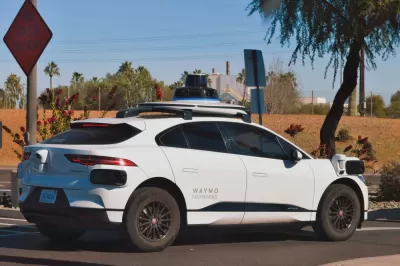
What’s a self-driving car to do when it’s not doing its job? For Waymo vehicles in Phoenix, the answer is parking, lights and sensors still on, in legal curbside parking spots, reports Lane Sainty for Arizona Republic.
According to Waymo, “Continuing to drive around would add to traffic congestion and be inefficient, he said, and waiting nearby — as opposed to going back to a Waymo facility — means vehicles can arrive quickly when called.”
The Waymo rollout in Phoenix, like in other cities, hasn’t been entirely smooth. “On April 7, a busy First Friday night downtown, a number of self-driving Waymo vehicles came to a stop along First Street, the resulting traffic jam captured in a viral TikTok. And on Wednesday morning, an autonomous Waymo vehicle stopped unexpectedly in the middle of Roosevelt Row, forcing commuters to drive around it.”
In San Francisco, writes Joe Eskenazi in a Mission Local article, self-driving cars are causing even bigger headaches, in some cases impeding emergency vehicles and personnel and driving into dangerous situations. “To date, no firefighter has been run over, and no fire victim has suffered because emergency personnel have been unable to move their vehicles or access fire hydrants. But this, like the fact there was no electricity running through those downed Muni wires, appears to be a series of lucky breaks.”
FULL STORY: Where do driverless cars go when they're on break? Some idle in Phoenix neighborhoods

Waymo Expansion Makes Phoenix ‘World’s Largest Self-Driving Car Zone’
The company’s autonomous taxis will soon be available in most parts of the metro area including Tempe, Mesa, and a new airport pick-up location.
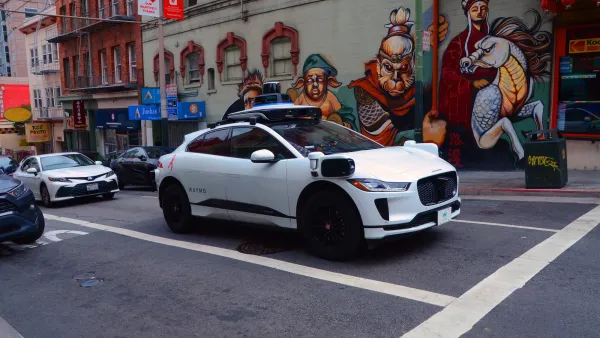
Feds say robotaxis interfering with first responders is a 'functional insufficiency,' demand solutions by August
The NHTSA issued a letter to autonomous carmakers, noting that 'Every second matters when law enforcement officers, firefighters, or paramedics are answering a call.'
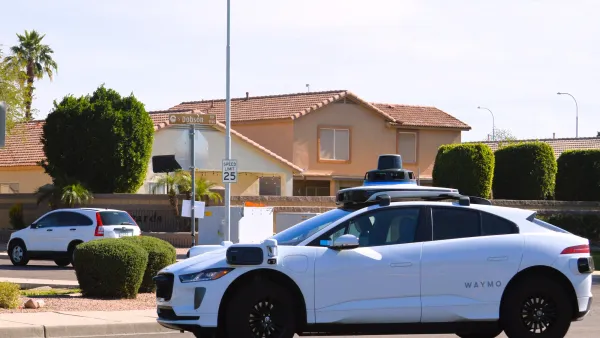
Uber and Waymo part ways in Phoenix
The companies ended a three-year pilot program, with Waymo saying it plans to keep its Phoenix robotaxi fleet available through its own app.

Planetizen Federal Action Tracker
A weekly monitor of how Trump’s orders and actions are impacting planners and planning in America.

The state-sanctioned urbicide of Austin
People don’t kill cities. Freeways do.

US to reduce Colorado River water deliveries to Mexico
A new Colorado Treaty amendment reduces Mexico’s Colorado River water allocation by 250,000 acre feet.

Baltimore to break ground on $50 million Transit Priority Project
The project will bring faster bus trips, safer streets and better bike connections to Baltimore.

Airbnb launches $250 million 'last-dollar financing' housing accelerator, makes first investment in Austin
The company will put $6.4 million towards affordable housing development in Texas’ capital.

Guerilla urbanists are building DIY bus stop benches in Chicago
A before-and-after of one of the bus stops with a new bench. The new benches are not officially sanctioned or permitted, but the residents who placed them hope they will be the start of a network of DIY benches across the city.

FREE Course: Walkable City 1: Why Walkability?
After describing his path towards focusing on walkability as the essence of good planning, Jeff Speck marches through his five principal reasons for making more walkable places.
Reinventing Malls: Planning Alchemy—Turning Gray Fields Into Gold
The course focuses on the opportunities and imperatives that shape reinvention of mall sites.

Eagle County Government
Harvard University Graduate School of Design
Nashville Planning Department
The Architects Foundation
University of Cincinnati Online
The Pocatello Development Authority
The Urban Renewal Agency of the City of Pocatello
Journal of the American Planning Association