Housing markets are failing to price in climate risks in their assessment of housing values, according to a recent study published by Nature.


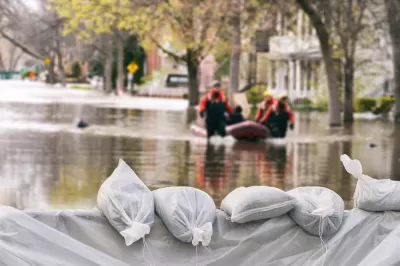
A study recently published by the journal Nature finds that U.S. residential properties exposed to flood risk are overvalued by between $121 billion and $237 billion.
The number of homes in the United States at risk of flooding, especially as extreme weather becomes more frequent as a result of climate change, accounts for some of that risk, according to the study. “Currently, more than 14.6 million properties in the United States face at least a 1% annual probability of flooding, reads the abstract. The study assumes that climate change will increase that total by 11 percent.
The journal article, authored by Jesse D. Gourevitch, Carolyn Kousky, Yanjun (Penny) Liao, Christoph Nolte, Adam B. Pollack, Jeremy R. Porter, and Joakim A. Weill is available in full online.
Read the full story: Unpriced climate risk and the potential consequences of overvaluation in US housing markets

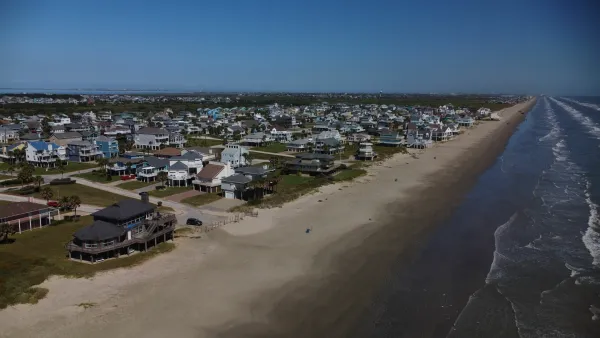
Looking for a Beach House? Check Your Risk First.
A new report from the insurance industry names the historic town of Galveston, Texas as the riskiest place to buy a beach house in the United States.
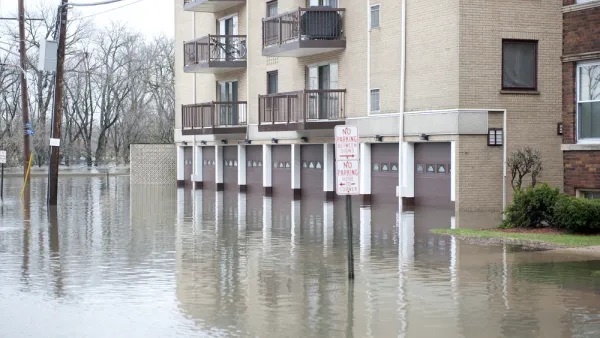
New Study Reveals Massive, Unaccounted Flood Risk
The Federal Emergency Management Agency undercounts the humber of homes at substantial risk of flooding by some 70 percent, according to a report released this week.
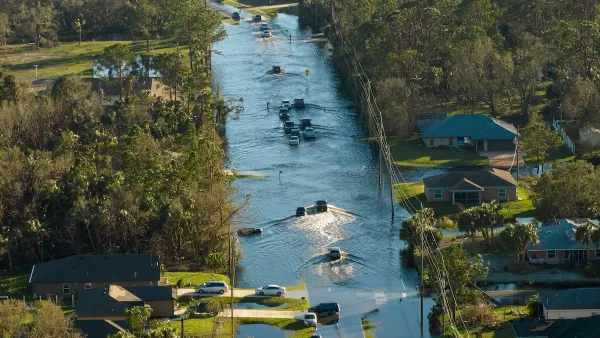
New Florida Law Bars Communities From Planning for Climate, Disaster Resilience
A law aimed at speeding up redevelopment after hurricanes bars “burdensome” land use regulations that could help communities rebuild with more resilience.

Planetizen Federal Action Tracker
A weekly monitor of how Trump’s orders and actions are impacting planners and planning in America.

California plans to bury El Niño’s downpour
If the state plays its cards right, it may be able to store a billion acre-feet of El Niño’s water in aquifers.

Chicago breaks ground on $3 billion megadevelopment
The new neighborhood, titled Foundry Park, will one day host 3,700 residences.

Satanic Place Names
From streams and lakes to valleys and canyons, I mapped more than 1,000 places named after the Devil.

California High-Speed Rail Authority CEO resigns after $600,000 scandal
Under Ian Choudri, the authority used taxpayer dollars to fund first class flights and trips to nightclubs.

Want to study the Missouri River? Soon, you may need unanimous approval from 10 states
Legislation would require 10 governors’ permission to study or build projects moving water outside the basin.

FREE Course: Walkable City 1: Why Walkability?
After describing his path towards focusing on walkability as the essence of good planning, Jeff Speck marches through his five principal reasons for making more walkable places.
Reinventing Malls: Planning Alchemy—Turning Gray Fields Into Gold
The course focuses on the opportunities and imperatives that shape reinvention of mall sites.

City of Rosemead
Rutgers University, Edward J. Bloustein School of Planning and Public Policy
One Hundred Miles
Hunter College, City University of New York (CUNY)
The Architects Foundation
University of Cincinnati Online
City of Cambridge
Montrose County
The Pocatello Development Authority