Determinations made by the Coast Guard to accommodate superyachts will affect the price of light rail and other bridge projects in Seattle and environs.



“In order to accommodate the superyacht community, the United States Coast Guard has determined that fixed bridges crossing Seattle’s Ship Canal between Puget Sound, the Ballard Locks, and Fremont must have at least 205 feet of vertical clearance,” reports Ray Dubicki for The Urbanist.
The decision to raise bridge heights above other bridges in the area, like the Aurora Bridge and the Ballard Bridge, is a result of the planning process for Sound Transit’s planned extension of light rail to Ballard, but as noted by Dubicki the requirement will impact plans for the Salmon Bay rail bridge and the future replacement of the Ballard Bridge.
“Horizontal bridge clearances were also included in the determination, and found some proposed Sound Transit bridge designs required wider clearances to avoid collisions in the narrow channel,” adds Dubicki.
The height requirements, along with width requirements, are expected to make the rail projects more expensive, but Sound Transit is still trying to figure out the exact impacts of the determination.
The source article below includes more details on the determination and the ongoing coordination between Sound Transit and the Coast Guard.
Read the full story: Superyachts Push Ballard Bridges Soaring to New Heights

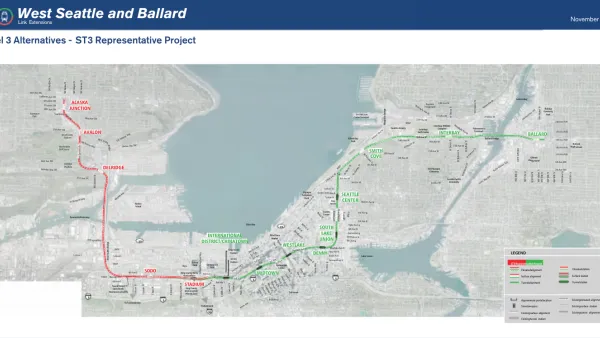
Alternatives Explored for West Seattle and Ballard Light Rail Extensions
Plans to extend the Sound Transit light rail system are moving forward. Elected officials have a big choice to make that will determine the cost and scope of the projects.
Checking in on the Progress of the Sound Transit 3 Plan
The Seattle area's $53.8 billion transit expansion plan is moving along in fits and starts.
Price Tag Jumps for Seattle Light Rail Projects
Land values and construction costs have increased since voters approved the Sound Transit 3 ballot initiative.

Planetizen Federal Action Tracker
A weekly monitor of how Trump’s orders and actions are impacting planners and planning in America.

California plans to bury El Niño’s downpour
If the state plays its cards right, it may be able to store a billion acre-feet of El Niño’s water in aquifers.

Chicago breaks ground on $3 billion megadevelopment
The new neighborhood, titled Foundry Park, will one day host 3,700 residences.

California High-Speed Rail Authority CEO resigns after $600,000 scandal
Under Ian Choudri, the authority used taxpayer dollars to fund first class flights and trips to nightclubs.

Want to study the Missouri River? Soon, you may need unanimous approval from 10 states
Legislation would require 10 governors’ permission to study or build projects moving water outside the basin.

Desperate measures: Advocates weigh draining Lake Powell to fill Colorado River
Draining the reservoir could reduce evaporation losses by a couple hundred thousand acre-feet.

FREE Course: Walkable City 1: Why Walkability?
After describing his path towards focusing on walkability as the essence of good planning, Jeff Speck marches through his five principal reasons for making more walkable places.
Reinventing Malls: Planning Alchemy—Turning Gray Fields Into Gold
The course focuses on the opportunities and imperatives that shape reinvention of mall sites.

City of Rosemead
Rutgers University, Edward J. Bloustein School of Planning and Public Policy
One Hundred Miles
Hunter College, City University of New York (CUNY)
The Architects Foundation
University of Cincinnati Online
City of Cambridge
Montrose County
The Pocatello Development Authority