The Court's decision could limit the agency's authority to regulate carbon emissions in the power sector.



As President Biden heads to the international climate summit in Glasgow this week, the U.S. Supreme Court has announced plans to hear appeals that could limit the Environmental Protection Agency's power to regulate emissions, reports Greg Stohr.
"The conservative-controlled court will review a federal appeals court decision that critics say gave the EPA sweeping authority to reshape key sectors of the U.S. economy, going well beyond what Congress envisioned when it enacted the Clean Air Act," writes Stohr.
The appeals court ruling reversed a policy enacted by the Trump administration that only allowed the EPA to control carbon emissions "at the source" of power plants rather than taking a sector-wide approach.
Stohr quotes former EPA assistant administrator Jeff Holmstead as saying the decision comes as "a big surprise" that will set back the Biden administration's efforts to impose stricter regulations on the power sector and limit the EPA's powers just as the country has set ambitious emissions reduction goals.
The Court will hear arguments early next year, and a decision is expected by late June 2022.
Read the full story: Top Court Takes Up Climate Challenge in Pre-Summit Jolt to Biden

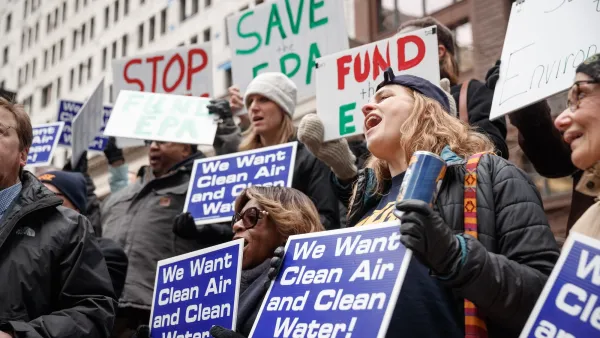
EPA Guts Emissions Regulations
The agency is eliminating the endangerment finding that underpins the agency’s authority to regulate greenhouse gas emissions.

LA’s Trees Absorb More Carbon Than Expected, But Can’t Do It Alone
A USC study finds that Los Angeles’ urban trees absorb more carbon than expected, but while they provide crucial environmental benefits, they cannot replace the urgent need for systemic emissions reductions.
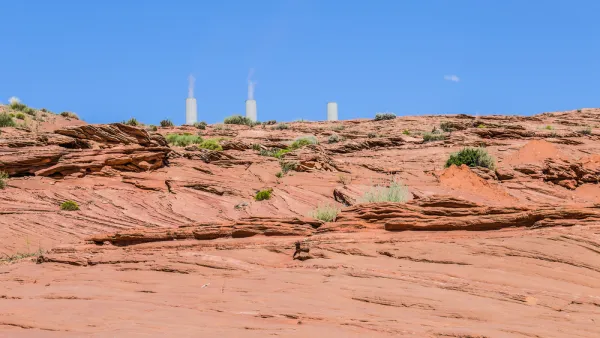
The Inflation Reduction Act's Secret Climate Weapon
While the impact on inflation of the questionably-titled Inflation Reduction Act remains to be seen, the law will mitigate the damage done by a landmark Supreme Court case in June that gutted the EPA's authority to regulate greenhouse gas emissions.

Planetizen Federal Action Tracker
A weekly monitor of how Trump’s orders and actions are impacting planners and planning in America.

The state-sanctioned urbicide of Austin
People don’t kill cities. Freeways do.

US to reduce Colorado River water deliveries to Mexico
A new Colorado Treaty amendment reduces Mexico’s Colorado River water allocation by 250,000 acre feet.

Nation's most wind-powered state turns to coal as data centers increase energy demand
For the first time in decades, Iowa has increased its generation of coal power.

NYC cools commuters with city's first rain garden above a bus stop
New York City officials say the plants in the rain garden can absorb 16 gallons of rainwater during heavy storms.

Brightline West’s future may rely on $6 billion federal loan
The company has until Nov. 2 to make a $400 million equity investment into its proposed high-speed rail line.

FREE Course: Walkable City 1: Why Walkability?
After describing his path towards focusing on walkability as the essence of good planning, Jeff Speck marches through his five principal reasons for making more walkable places.
Reinventing Malls: Planning Alchemy—Turning Gray Fields Into Gold
The course focuses on the opportunities and imperatives that shape reinvention of mall sites.

Greater Baltimore Committee
Eagle County Government
Harvard University Graduate School of Design
The Architects Foundation
University of Cincinnati Online
The Pocatello Development Authority
The Urban Renewal Agency of the City of Pocatello
Journal of the American Planning Association