The city of Houston this week launched an app for its Community Connector shuttle service as part of a ten-month pilot project.


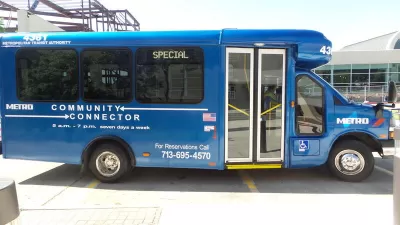
"Taking a cue from ride-hailing services, the Metropolitan Transit Authority plans to debut an app next week that will allow riders to book trips with its existing on-demand shuttles," reports Dug Begley in a paywalled article for the Houston Chronicle.
"Once it goes live Sept. 8 in two areas, the app will bring an Uber-like interaction to shuttle users in Metro’s three established Community Connector zones, including the ability to rate the service and the driver," adds Begley.
The app, called curb2curb, adds a new way to access existing on-demand transit service through the Community Connector service, launched simultaneously with Houston's vaunted bus system redesign in 2015.
The app is being launched in a 10-month pilot project, reports Begley. The pilot "will study whether an app and so-called microtransit services such as neighborhood shuttles serve a demand in Houston that makes financial sense." The curb2curb app will be offered for Community Connector service in three parts of the Metropolitan Transit Authority of Harris County service area: Missouri City, Acres Homes, and a large area north of Kashmere Gardens.
Read the full story: Transit on demand: Metro launches app to boost neighborhood shuttle program

Houston Metro Secures Long-Term Funding for On-Demand Microtransit
The agency is working to integrate the Community Connector service into Houston’s broader transit network.
Houston Council Member Questions Microtransit Investment
METRO’s support of an on-demand microtransit service comes as the agency is scaling back its bigger bus projects.
New App Would Enable On-Demand Public Transit
As transportation network companies like Uber and Bridj make it easier for some to opt out of the public transit system, a new app would help transit agencies offer more user-centric services.

Planetizen Federal Action Tracker
A weekly monitor of how Trump’s orders and actions are impacting planners and planning in America.

California plans to bury El Niño’s downpour
If the state plays its cards right, it may be able to store a billion acre-feet of El Niño’s water in aquifers.

Chicago breaks ground on $3 billion megadevelopment
The new neighborhood, titled Foundry Park, will one day host 3,700 residences.

California High-Speed Rail Authority CEO resigns after $600,000 scandal
Under Ian Choudri, the authority used taxpayer dollars to fund first class flights and trips to nightclubs.

Want to study the Missouri River? Soon, you may need unanimous approval from 10 states
Legislation would require 10 governors’ permission to study or build projects moving water outside the basin.

Desperate measures: Advocates weigh draining Lake Powell to fill Colorado River
Draining the reservoir could reduce evaporation losses by a couple hundred thousand acre-feet.

FREE Course: Walkable City 1: Why Walkability?
After describing his path towards focusing on walkability as the essence of good planning, Jeff Speck marches through his five principal reasons for making more walkable places.
Reinventing Malls: Planning Alchemy—Turning Gray Fields Into Gold
The course focuses on the opportunities and imperatives that shape reinvention of mall sites.

City of Rosemead
Rutgers University, Edward J. Bloustein School of Planning and Public Policy
One Hundred Miles
Hunter College, City University of New York (CUNY)
The Architects Foundation
University of Cincinnati Online
City of Cambridge
Montrose County
The Pocatello Development Authority