A truly ambitious, and thoroughly innovative development, project in St. Louis will adapt a former hospital facility to house numerous nonprofit and neighborhood investment organizations.


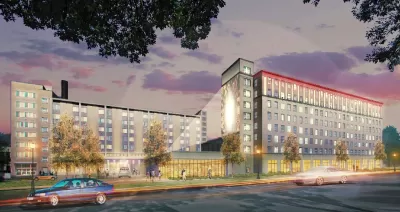
Rachel Rice reports on a proposal to develop the former St. Luke’s Hospital, located on Delmar Boulevard in St. Louis, which shut down after bankruptcy in 2013, operating at the time as ConnectCare.
"But come fall 2021, the 500,000-square-foot building will begin its second life — housing apartments, offices, a cafe and a highly anticipated nonprofit collaborative," reports Rice.
The project will be called the Delmar DivINe, named to counter the racial and income stratification that comes with the “Delmar Divide” moniker. [Maxine] Clark and Executive Director Jorge Riopedre anticipate closing on the project within the next few weeks and are completing leases with more than 20 different organizations and nonprofits.
Nonprofits such as the Mid-America Transplant Foundation and Humanitri are likely to be tenants, along with Washington University and the St. Louis Community Credit Union, all as part of a $100 million project that could transform a portion of the city near the Delmar Loop. Supporters say the project is precisely the kind of heavy investment needed to invigorate neighborhoods that fall just north of Delmar.
Maxine Clark, the founder of Build-a-Bear, came up with the idea for the project after working in the Cortex Innovation Community, which offers office space, capital, mentoring and networking opportunities to businesses, according to the article.
The project has already been delayed because of the effects of the Covid-19 pandemic, but initial phases of construction will focus on nonprofit working spaces and residential apartments before later phases build out more office space and services such as early childhood education.
"The project is funded through a public-private partnership that includes a loan guarantee from the federal Department of Housing and Urban Development, new market and historic tax credits, and donations, including Clark’s own funding," reports Rice.
Additional coverage of Delmar Divine is also available in a more recent article by Amanda Woytus for St. Louis Magazine.
Read the full story: Ambitious $100 million St. Louis project hopes to erase ‘Delmar Divide’


Surveying the Rising Trend of Office-to-Residential Conversions
With office vacancies climbing and a stubborn supply crunch driving up the cost of housing, some downtowns have emerged at the forefront of a new wave of adaptive reuse.
Looking to Vacant Retail Spaces for Needed Housing Supply
The Phoenix City Council has taken the first steps toward zoning reforms that can balance out the oversupply of retail spaces at one end of the market and the lack of housing units at the other.
Walkable Waterfront Takes Shape on the Schuylkill River Near Philadelphia
The Pencoyd Landing development is focused on providing access to pedestrians, cyclists, and transit users in the neighborhood of Lower Merion Township, across the Schuylkill River from Philadelphia.

Planetizen Federal Action Tracker
A weekly monitor of how Trump’s orders and actions are impacting planners and planning in America.

The state-sanctioned urbicide of Austin
People don’t kill cities. Freeways do.

US to reduce Colorado River water deliveries to Mexico
A new Colorado Treaty amendment reduces Mexico’s Colorado River water allocation by 250,000 acre feet.

Nation's most wind-powered state turns to coal as data centers increase energy demand
For the first time in decades, Iowa has increased its generation of coal power.

NYC cools commuters with city's first rain garden above a bus stop
New York City officials say the plants in the rain garden can absorb 16 gallons of rainwater during heavy storms.

Brightline West’s future may rely on $6 billion federal loan
The company has until Nov. 2 to make a $400 million equity investment into its proposed high-speed rail line.

FREE Course: Walkable City 1: Why Walkability?
After describing his path towards focusing on walkability as the essence of good planning, Jeff Speck marches through his five principal reasons for making more walkable places.
Reinventing Malls: Planning Alchemy—Turning Gray Fields Into Gold
The course focuses on the opportunities and imperatives that shape reinvention of mall sites.

Greater Baltimore Committee
Eagle County Government
Harvard University Graduate School of Design
The Architects Foundation
University of Cincinnati Online
The Pocatello Development Authority
The Urban Renewal Agency of the City of Pocatello
Journal of the American Planning Association