An annual survey by the Mineta Transportation Institute found new levels of support for a change in the way the federal government raises money from, and for, highway infrastructure.


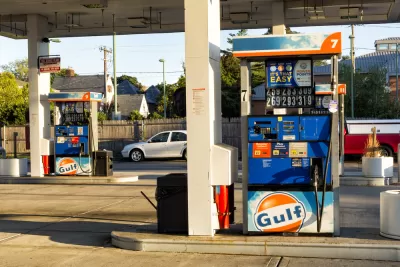
"Nearly half of Americans think it’s time to rethink how we fund our road infrastructure by switching from a federal gas tax — which theoretically rewards drivers for choosing greener cars, but doesn’t always deter excessive driving itself — and replacing it with a tax based on how many miles drivers actually travel," according to an article by Kea Wilson.
Wilson is sharing the findings of newly released survey findings from the Mineta Transportation Institute. "Forty-five percent of respondents said they would prefer a flat mileage fee to a gas tax, while 49 percent said they’d prefer a 'green' mileage fee that charges drivers of high-polluting cars a little more, and drivers of more-efficient cars a little less — the highest levels of support the researchers have found in the 10 years since the survey began," explains Wilson.
The article includes a thorough explanation of the gas tax, the fragile and perpetually threatened state of the Highway Trust Fund, and the benefits of changing for Vehicle Miles Traveled (VMT).
Read the full story: Half of Americans Want Drivers Who Drive More to Pay More

California Poised to Lose Up to $4 Billion in Gas Tax Revenue
States must find other ways to fund transportation projects as the transportation sector moves toward decarbonization.

An Argument Against VMT Fees as Replacements for Gas Taxes
Vehicle Miles Traveled (VMT) fees are a bad way to pay for roads, according to an article by Joe Cortright.
The Looming Era of VMT
The gas tax is becoming an increasingly outdated and unsustainable idea. This piece from Miller McCune looks at the prospect of replacing it with a tax based on vehicle miles traveled.

Planetizen Federal Action Tracker
A weekly monitor of how Trump’s orders and actions are impacting planners and planning in America.

California plans to bury El Niño’s downpour
If the state plays its cards right, it may be able to store a billion acre-feet of El Niño’s water in aquifers.

Chicago breaks ground on $3 billion megadevelopment
The new neighborhood, titled Foundry Park, will one day host 3,700 residences.

California High-Speed Rail Authority CEO resigns after $600,000 scandal
Under Ian Choudri, the authority used taxpayer dollars to fund first class flights and trips to nightclubs.

Want to study the Missouri River? Soon, you may need unanimous approval from 10 states
Legislation would require 10 governors’ permission to study or build projects moving water outside the basin.

Desperate measures: Advocates weigh draining Lake Powell to fill Colorado River
Draining the reservoir could reduce evaporation losses by a couple hundred thousand acre-feet.

FREE Course: Walkable City 1: Why Walkability?
After describing his path towards focusing on walkability as the essence of good planning, Jeff Speck marches through his five principal reasons for making more walkable places.
Reinventing Malls: Planning Alchemy—Turning Gray Fields Into Gold
The course focuses on the opportunities and imperatives that shape reinvention of mall sites.

City of Rosemead
Rutgers University, Edward J. Bloustein School of Planning and Public Policy
One Hundred Miles
Hunter College, City University of New York (CUNY)
The Architects Foundation
University of Cincinnati Online
City of Cambridge
Montrose County
The Pocatello Development Authority