President Trump is trying to marshal votes by raising fears about the effects of the Affirmatively Fair Housing Act on the suburbs, where the president is losing support among voters.


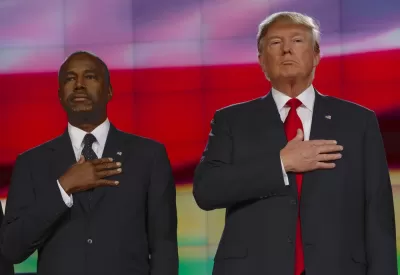
Ashraf Khalil writes for the Associated Press to amplify the message of advocates with strong criticisms for President Donald Trump's recent attacks on fair housing laws.
Planetizen provided a rundown of the president's recent statements in context of the Trump administration's efforts to weaken the Affirmatively Furthering Fair Housing (AFFH) rule, approved during the Obama administration to strengthen the anti-segregation measures of the Fair Housing Act of 1968.In recent weeks, the president's rhetoric about the effects of the AFFh has grown increasingly heightened. An editorial published by the St. Louis Post-Dispatch says the Trump's leverage of the suburbs and the AFFH to score election points is more than a racist dog whistle: "It's a bullhorn." The Dallas Morning News editorial board also published a rebuttal to Trumps's anti-AFFh rhetoric (paywall).
Khalil gets soundbites from two advocates who say the president's recent statements are a political stunt, including Debby Goldberg, vice president of housing policy and special projects for the National Fair Housing Alliance, and Diane Yentel, president of the National Low-Income Housing Coalition.
FULL STORY: Fair Housing Groups Slam Trump's Suburban Racial Rhetoric

Planning Fair: How Fair Housing Intersects with Planning
The successful implementation of fair housing laws requires the active participation of urban planners, land use boards, elected officials, and the wider planning community.
White House Reinstates Affirmatively Furthering Fair Housing Rule
The Affirmatively Furthering Fair Housing rule is back, but with one critical change that seems to respond to complaints used by Trump administration officials to rescind the rule in 2020.
Boston to Require Fair Housing Review for New Developments
The Boston Zoning Code is one of the first in the nation to Affirmatively Furthering Fair Housing.

Planetizen Federal Action Tracker
A weekly monitor of how Trump’s orders and actions are impacting planners and planning in America.

The state-sanctioned urbicide of Austin
People don’t kill cities. Freeways do.

US to reduce Colorado River water deliveries to Mexico
A new Colorado Treaty amendment reduces Mexico’s Colorado River water allocation by 250,000 acre feet.

5 New England states march closer to 800 megawatt wind energy project
Securing federal approval for the project may be complicated under the Trump administration, which has historically been hostile towards domestic wind power.

Baltimore to break ground on $50 million Transit Priority Project
The project will bring faster bus trips, safer streets and better bike connections to Baltimore.

Airbnb launches $250 million 'last-dollar financing' housing accelerator, makes first investment in Austin
The company will put $6.4 million towards affordable housing development in Texas’ capital.

FREE Course: Walkable City 1: Why Walkability?
After describing his path towards focusing on walkability as the essence of good planning, Jeff Speck marches through his five principal reasons for making more walkable places.
Reinventing Malls: Planning Alchemy—Turning Gray Fields Into Gold
The course focuses on the opportunities and imperatives that shape reinvention of mall sites.

Eagle County Government
Harvard University Graduate School of Design
Nashville Planning Department
The Architects Foundation
University of Cincinnati Online
The Pocatello Development Authority
The Urban Renewal Agency of the City of Pocatello
Journal of the American Planning Association