The president of Hudson Companies and The Planning Report’s first editor, David Kramer, discusses New York City’s COVID response and recovery and its likely impact on multifamily housing development going forward.


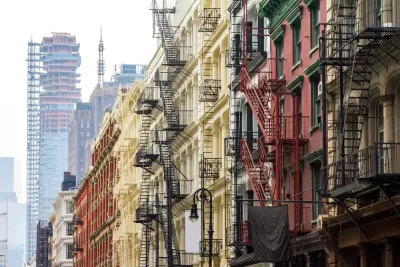
Public fear of contagion has ignited—as disasters and crises often do—an examination on the appeal of city life and especially the appeal of urban density and reliance on public transit. To better understand how COVID is impacting residential preferences in New York City, TPR caught up with the president of Hudson Companies and TPR’s first editor, David Kramer, to better understand his city’s COVID response and recovery and its likely impact on multifamily housing development going forward.
A self-proclaimed NYC booster, Kramer affirms his bullish outlook for the city and calls for a “Manhattan Project for Testing" to restore public confidence in urban life.
"New York City does not and will never have enough housing or new supply, and I just think that down the road when the smoke clears, people are going to want to live in New York as they have for the last 30 years." —David Kramer
For the full interview, visit The Planning Report.
Read the full story: Hudson’s David Kramer on NYC’s Pandemic-Proof Real Estate


The Future of Downtowns Still Hangs in the Balance
Center City in Philadelphia offers a case study for one of the largest and potentially most consequential contingencies of the pandemic: What happens to downtowns is most workers never come back to the office?

Detroit as a Model for 'Building Back Better'
Cities have more experience, and examples, than they might realize when it comes to reinventing systems of investment and governance to recover from the economic ravages of the COVID-19 pandemic.

Office Demand in Seattle Suddenly Back and Bigger Than Ever
The fortunes of commercial real estate in Seattle have completely reversed since February, according to a new analysis.

Planetizen Federal Action Tracker
A weekly monitor of how Trump’s orders and actions are impacting planners and planning in America.

California plans to bury El Niño’s downpour
If the state plays its cards right, it may be able to store a billion acre-feet of El Niño’s water in aquifers.

Chicago breaks ground on $3 billion megadevelopment
The new neighborhood, titled Foundry Park, will one day host 3,700 residences.

Satanic Place Names
From streams and lakes to valleys and canyons, I mapped more than 1,000 places named after the Devil.

California High-Speed Rail Authority CEO resigns after $600,000 scandal
Under Ian Choudri, the authority used taxpayer dollars to fund first class flights and trips to nightclubs.

Want to study the Missouri River? Soon, you may need unanimous approval from 10 states
Legislation would require 10 governors’ permission to study or build projects moving water outside the basin.

FREE Course: Walkable City 1: Why Walkability?
After describing his path towards focusing on walkability as the essence of good planning, Jeff Speck marches through his five principal reasons for making more walkable places.
Reinventing Malls: Planning Alchemy—Turning Gray Fields Into Gold
The course focuses on the opportunities and imperatives that shape reinvention of mall sites.

City of Rosemead
Rutgers University, Edward J. Bloustein School of Planning and Public Policy
One Hundred Miles
Hunter College, City University of New York (CUNY)
The Architects Foundation
University of Cincinnati Online
City of Cambridge
Montrose County
The Pocatello Development Authority