More and more New Yorkers will face the prospect of encroaching seas in the coming decades, and the unwanted choice of whether to stay or to go.


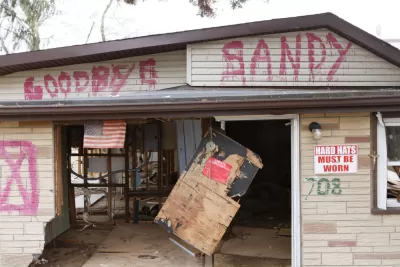
According to an article by Ilana Cohen, managed retreat has become a de facto part of life in certain areas of New York City.
"Though not all residents have been presented with equal choices in the matter, many on the city's waterfront have voluntarily participated in government-funded home buyout programs, abandoning their longtime residences to seek higher ground."
The home buyout option is available through the city's Build it Back program, "which seeks to support Sandy-impacted residents with their recovery needs by working with them directly to help repair, rebuild, and elevate their homes—or, when necessary, to relocate entirely."
Also according to the article, some local residents say the city's response to the flood risk has lacked a comprehensive plan, and others are choosing to stay, despite the dire reports of the expected impact of sea-level rise in coastal stretches of the city.
FULL STORY: In New York City, ‘Managed Retreat’ Has Become a Grim Reality


Lower Manhattan Climate Resilience Plan Released
The Financial District and Seaport Climate Resilience Master Plan will extend the shoreline in Lower Manhattan by up to 200 feet.
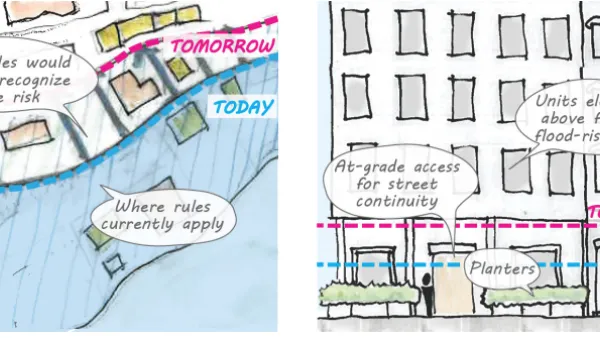
Proposed Citywide Rezoning Would Layer Resilience in New York City
With 520 miles of coastline, New York City is ready to implement the lessons of Hurricane Sandy in the zoning code for the entire city.
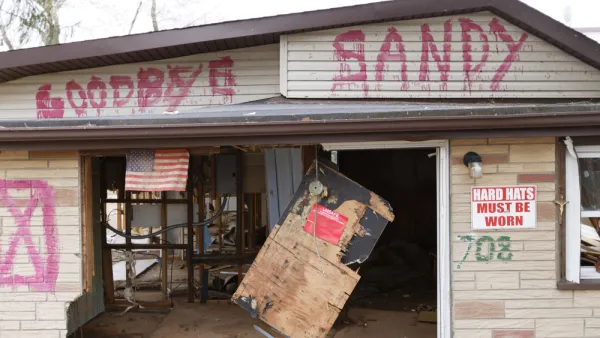
Watch: Sea Walls and the Future of Resilience
Vox and Curbed provide multi-media coverage of a Staten Island sea wall project as an example of the necessity of resilient infrastructure, and the shortcomings of our ability to predict the needs of the built environments in changed climates.

Planetizen Federal Action Tracker
A weekly monitor of how Trump’s orders and actions are impacting planners and planning in America.

The state-sanctioned urbicide of Austin
People don’t kill cities. Freeways do.

US to reduce Colorado River water deliveries to Mexico
A new Colorado Treaty amendment reduces Mexico’s Colorado River water allocation by 250,000 acre feet.

5 New England states march closer to 800 megawatt wind energy project
Securing federal approval for the project may be complicated under the Trump administration, which has historically been hostile towards domestic wind power.

Baltimore to break ground on $50 million Transit Priority Project
The project will bring faster bus trips, safer streets and better bike connections to Baltimore.

Airbnb launches $250 million 'last-dollar financing' housing accelerator, makes first investment in Austin
The company will put $6.4 million towards affordable housing development in Texas’ capital.

FREE Course: Walkable City 1: Why Walkability?
After describing his path towards focusing on walkability as the essence of good planning, Jeff Speck marches through his five principal reasons for making more walkable places.
Reinventing Malls: Planning Alchemy—Turning Gray Fields Into Gold
The course focuses on the opportunities and imperatives that shape reinvention of mall sites.

Eagle County Government
Harvard University Graduate School of Design
Nashville Planning Department
The Architects Foundation
University of Cincinnati Online
The Pocatello Development Authority
The Urban Renewal Agency of the City of Pocatello
Journal of the American Planning Association