St. Louis stakeholders hope to build on the momentum provided by the arrival of the new western headquarters of the National Geospatial-Intelligence Agency.



"A group of St. Louis economic development and civic leaders released a plan Tuesday detailing how the region could turn the geospatial industry into a global hub over the next 10 years," reports Corinne Ruff.
"The plan, dubbed GeoFutures, outlines next steps for developing the workforce, infrastructure and entrepreneurship needed to attract more companies and investors in the industry," adds Ruff.
The report is building on the momentum created by the National Geospatial-Intelligence Agency's new western headquarters, under construction in north St. Louis. The campus is expected to employ 3,000 people by 2025.
To achieve its goals of positioning St. Louis as a global hub of the geospatial industry, the GeoFutures recommends five priorities: 1) Scale up local geospatial talent and workforce development, 2) Raise innovation capacity for the commercialization of geospatial applications, 3) Increase entrepreneurship and pools of investor money, 4) Support community-driven development in neighborhoods around the new NGA West, and 5) Brand St. Louis as a global thought leader in geospatial technology.
According to the article, the GeoFutures plan is "one piece of a much larger city-backed initiative to bring economic equality and growth to St. Louis."
Read the full story: Plan Maps Out How St. Louis Could Become A Global Geospatial Hub Over Next Decade

The Massive Redevelopment Plans for North St. Louis Failed—What Next?
Detroit has Dan Gilbert, and for a few years, it looked like St. Louis had Paul McKee. Now that McKee's massive plans for the redevelopment of North St. Louis have failed expectations, what has been lost and what, potentially, can still be gained?
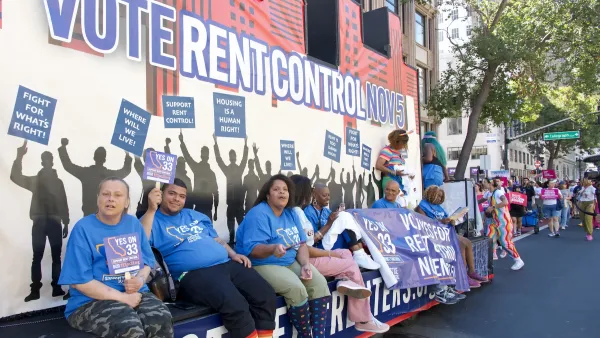
Oakland residents fear AI-fueled gentrification
The new tech boom that's driving up rents in San Francisco could have rippling impacts on East Bay communities.
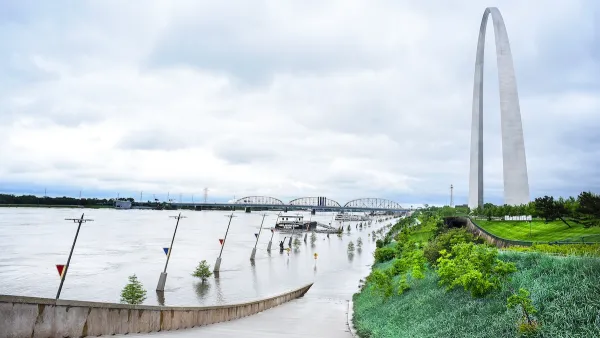
St. Louis has a Secret Stormwater Weapon Saving 100 Million Gallons from the Mississippi
The city reimburses residents who install gardens, rain barrels, and other methods that retain stormwater and decrease the risk of flooding.

Planetizen Federal Action Tracker
A weekly monitor of how Trump’s orders and actions are impacting planners and planning in America.

The state-sanctioned urbicide of Austin
People don’t kill cities. Freeways do.

Colorado’s Largest Data Center Could Rise Next to Homes — Without a Public Hearing
The proposed campus would consume 11 times the power of Denver International Airport; as it has across the country, opposition mounts.

Nation's most wind-powered state turns to coal as data centers increase energy demand
For the first time in decades, Iowa has increased its generation of coal power.

NYC cools commuters with city's first rain garden above a bus stop
New York City officials say the plants in the rain garden can absorb 16 gallons of rainwater during heavy storms.

Brightline West’s future may rely on $6 billion federal loan
The company has until Nov. 2 to make a $400 million equity investment into its proposed high-speed rail line.

FREE Course: Walkable City 1: Why Walkability?
After describing his path towards focusing on walkability as the essence of good planning, Jeff Speck marches through his five principal reasons for making more walkable places.
Reinventing Malls: Planning Alchemy—Turning Gray Fields Into Gold
The course focuses on the opportunities and imperatives that shape reinvention of mall sites.

Greater Baltimore Committee
Eagle County Government
Harvard University Graduate School of Design
The Architects Foundation
University of Cincinnati Online
The Pocatello Development Authority
The Urban Renewal Agency of the City of Pocatello
Journal of the American Planning Association