Know before you go.


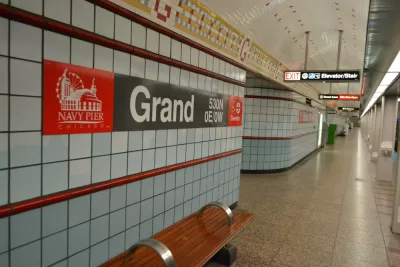
The Chicago Transit Authority (CTA) has released an online platform providing information about bus capacity to help inform social distancing while riding public transit as the city begins to reopen some sectors of its economy, reports Mary Wisniewski.
"The dashboard, posted on the CTA’s website, shows each bus route, with times of day marked with green, yellow or orange bars," according to Wisniewski. "Green indicates low ridership, yellow means some seats are available, and orange means the bus may be too crowded to safely board."
The platform relies on average ridership data for the previous two weeks, see real-time experience could differ from the platform's predictions, as riders attempt to navigate the CTA system under terms set by the Chicago Department of Public Health, which set capacity limits for buses and trains at "15 passengers on a standard 40-foot bus and 22 passengers on a 60-foot articulated bus and on each rail car," reports Wisniewski.
Many transit riders hoping to reconnoiter transit crowds before taking a trip also have the option to check Google.
Read the full story: CTA launches online tool to let passengers know when buses are too crowded

D.C. Metro Seeks Public Input on Proposed Service Cuts
D.C. Metro Seeks Public Input on Proposed Service Cuts
Public Transit in Crisis: Low-Income Riders Have the Most to Lose From Service Cuts
Riders who rely most on public transit are suffering the worst consequences of the cuts to service during the fiscal belt tightening of the coronavirus pandemic.
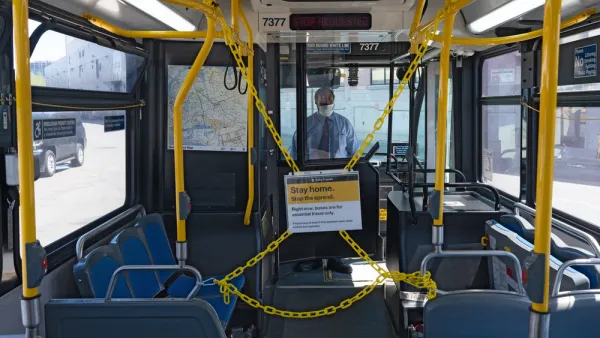
Ridership Up, Speeds Down for Buses in New York City
The new normal might be fleeting on buses in New York City, but it's already different than the normal routine during the early months of the pandemic.

Planetizen Federal Action Tracker
A weekly monitor of how Trump’s orders and actions are impacting planners and planning in America.

California plans to bury El Niño’s downpour
If the state plays its cards right, it may be able to store a billion acre-feet of El Niño’s water in aquifers.

Chicago breaks ground on $3 billion megadevelopment
The new neighborhood, titled Foundry Park, will one day host 3,700 residences.

Satanic place names
From streams and lakes to valleys and canyons, I mapped more than 1,000 places named after the Devil.

California High-Speed Rail Authority CEO resigns after $600,000 scandal
Under Ian Choudri, the authority used taxpayer dollars to fund first class flights and trips to nightclubs.

Want to study the Missouri River? Soon, you may need unanimous approval from 10 states
Legislation would require 10 governors’ permission to study or build projects moving water outside the basin.

FREE Course: Walkable City 1: Why Walkability?
After describing his path towards focusing on walkability as the essence of good planning, Jeff Speck marches through his five principal reasons for making more walkable places.
Reinventing Malls: Planning Alchemy—Turning Gray Fields Into Gold
The course focuses on the opportunities and imperatives that shape reinvention of mall sites.

City of Rosemead
Rutgers University, Edward J. Bloustein School of Planning and Public Policy
One Hundred Miles
Hunter College, City University of New York (CUNY)
The Architects Foundation
University of Cincinnati Online
City of Cambridge
Montrose County
The Pocatello Development Authority