A common part of the urban landscape, scaffolds are mostly ignored or detested. But these in-between spaces can also take on a life of their own.


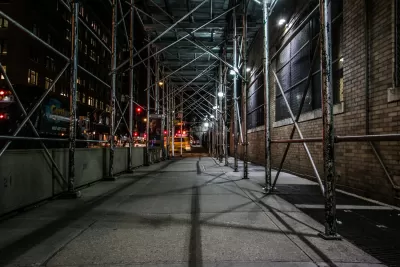
Penelope Green writes about the ubiquitous sidewalk scaffolding of New York City. She traces the history of scaffolding, about half of which is up because of Local Law 11, passed in 1980 to protect pedestrians from crumbling building facades in need of repair.
"The rest surround construction sites, and, taken together with those protecting facades, the whole adds up to more than 300 miles of scaffolding, much of it in Manhattan. If you think New York City is blanketed in the stuff, you are correct: just look at the Department of Buildings’ interactive map, with each sidewalk shed represented by a blue blob," says Green.
She also explores the diversity of uses of scaffolds—as art canvases, temporary shelter from the elements for humans and animals, and more permanent shelter for the homeless. Urban Umbrella is an attempt to redesign scaffolds to be more aesthetic elements of the urban landscape.
Scaffolding was also the subject of a show at the Center for Architecture, notes Green. "[Curator Greg Barton] wanted to rebrand it as an experimental kit of parts, he said, instead of a necessary nuisance and eyesore. The exhibition displayed work by designers like Assemble, a British collective, that has used scaffolding to design temporary theaters or follies than can be built by novices."
Read the full story: Our Lives, Under Construction

More Projects Adopt Pedestrian-Friendly Sidewalk Shed
Last year more than 9,000 sidewalk sheds dotted New York streets, protecting public safety and inspiring universal frustration.
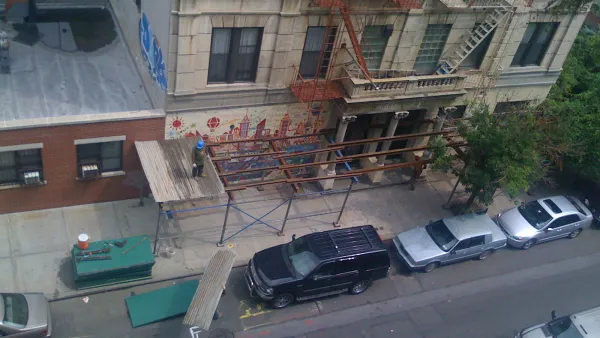
New York City's Sidewalk Shed Epidemic
A 1980 law protecting pedestrians from falling debris has spawned a labyrinth of sidewalk sheds: the covered walkways that often support scaffolding. Many of these "temporary" structures linger for years.
Why Walk Scores Don’t Tell the Whole Story
A popular measure of walkability only measures proximity, not safety or comfort.

Planetizen Federal Action Tracker
A weekly monitor of how Trump’s orders and actions are impacting planners and planning in America.

The state-sanctioned urbicide of Austin
People don’t kill cities. Freeways do.

US to reduce Colorado River water deliveries to Mexico
A new Colorado Treaty amendment reduces Mexico’s Colorado River water allocation by 250,000 acre feet.

Nation's most wind-powered state turns to coal as data centers increase energy demand
For the first time in decades, Iowa has increased its generation of coal power.

NYC cools commuters with city's first rain garden above a bus stop
New York City officials say the plants in the rain garden can absorb 16 gallons of rainwater during heavy storms.

Brightline West’s future may rely on $6 billion federal loan
The company has until Nov. 2 to make a $400 million equity investment into its proposed high-speed rail line.

FREE Course: Walkable City 1: Why Walkability?
After describing his path towards focusing on walkability as the essence of good planning, Jeff Speck marches through his five principal reasons for making more walkable places.
Reinventing Malls: Planning Alchemy—Turning Gray Fields Into Gold
The course focuses on the opportunities and imperatives that shape reinvention of mall sites.

Eagle County Government
Harvard University Graduate School of Design
Nashville Planning Department
The Architects Foundation
University of Cincinnati Online
The Pocatello Development Authority
The Urban Renewal Agency of the City of Pocatello
Journal of the American Planning Association