Last year more than 9,000 sidewalk sheds dotted New York streets, protecting public safety and inspiring universal frustration.


The sidewalk sheds accompanying new construction have long been a thorn in the side of New York residents. While mandated to protect pedestrians from potential falling objects, they're widely considered obtrusive and unsightly.
Toronto and New York projects are experimenting with an alternative shed designed by Urban Umbrella, which won a design competition convened by former Mayor Michael Bloomberg. Made of recycled steel, translucent plastic, and LED lights, the product "looks like an umbrella unfolding and allows natural light to hit sidewalks that would normally be darkened and narrowed by traditional sheds," Amanda Fung explains in Yahoo Finance.
It's not the first attempt to aestheticize the sidewalk shed—Zaha Hadid designed one in 2015—but most previous options haven't been cost-effective. Urban Umbrella's model is still more expensive than a standard shed, but creators say the price is dropping as projects in Boston, Québec, and Vancouver join the trend.
Read the full story: The ugly scaffold industry is about to be disrupted
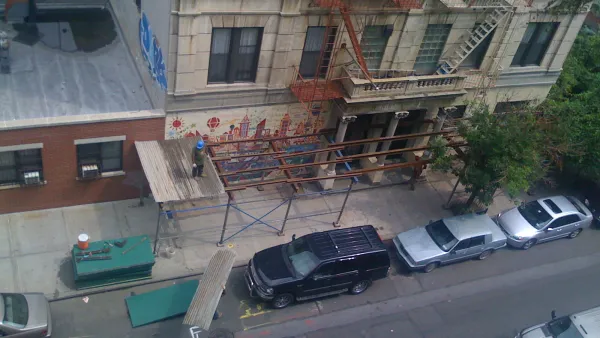
New York City's Sidewalk Shed Epidemic
A 1980 law protecting pedestrians from falling debris has spawned a labyrinth of sidewalk sheds: the covered walkways that often support scaffolding. Many of these "temporary" structures linger for years.

Art May Be Coming to New York City Sidewalk Sheds
Scaffolding and sidewalk sheds being a fixture of life in NYC, the city has decided to let artists do their thing with all that blank canvas.

The building wears Prada: Fifth Avenue designers raise the bar on sidewalk sheds
New York City fashion houses are getting creative with scaffolding.

Planetizen Federal Action Tracker
A weekly monitor of how Trump’s orders and actions are impacting planners and planning in America.

California plans to bury El Niño’s downpour
If the state plays its cards right, it may be able to store a billion acre-feet of El Niño’s water in aquifers.

Desperate measures: Advocates weigh draining Lake Powell to fill Colorado River
Draining the reservoir could reduce evaporation losses by a couple hundred thousand acre-feet.

In Texas, data centers are swallowing promised parkland
Residents who moved to Taylor, Texas for a rural community now have to contend with three data centers in their backyard.

How a Chicago-sized wind farm beat the odds and powered on
The project spanned five presidential administrations and a standoff with a U.S. military base.

MTA gives itself 30 days to transform pit into basketball court
The site has been under construction since 2022; the city originally estimated it would finish the court in 2024.

FREE Course: Walkable City 1: Why Walkability?
After describing his path towards focusing on walkability as the essence of good planning, Jeff Speck marches through his five principal reasons for making more walkable places.
Reinventing Malls: Planning Alchemy—Turning Gray Fields Into Gold
The course focuses on the opportunities and imperatives that shape reinvention of mall sites.

City of Rosemead
Rutgers University, Edward J. Bloustein School of Planning and Public Policy
One Hundred Miles
Hunter College, City University of New York (CUNY)
The Architects Foundation
University of Cincinnati Online
City of Cambridge
Montrose County
The Pocatello Development Authority