Local governments are fighting control after federal regulators removed some of the regulatory protections that could slow private companies from grabbing land in an effort



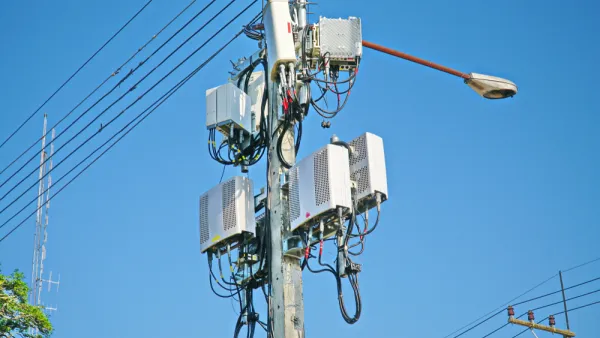
"Anxiety around the deployment [of 5G wireless Internet technology] has only been heightened in the wake of a Federal Communications Commission (FCC) decision handed down last year to accelerate approval times and cap fees that cities could charge for installing small cells, the infrastructure needed for 5G," reports Chris Teale.
"While some have turned to litigation to try and overturn the ruling — a bill pending in Congress would do the same — some experts suggest cities prepare a strong roll out plan for 5G."
Teale is sharing insights into just what form such local plans could take, shared by participants at the recent Smart Cities Connect conference in National Harbor, Maryland.
Previous coverage from Planetizen provides background on the ongoing debate between local governments and the federal government on the rollout of 5G technology.
- Feds Streamline Approvals for 5G Infrastructure (March 2018)
- Cities Sue Feds Over 5G Rules (October 2018)
- 2019 Already a Big Year For 'Smart City' Evolution (April 2019)
- 4 Regulatory Complications of 5G Infrastructure Development (May 2019)
- U.S. Falling Behind in Smart City Deployments and Key 21st Century Infrastructure (July 2019)
FULL STORY: Cities are facing 'an absolute land grab' from telecoms in wake of 5G

Feds Streamline Approvals for 5G Infrastructure
Most deployment of 5G "small cells" won't get any resistance from federal regulations.
Cities Sue Feds Over 5G Rules
Cities want more control over the deployment of 5G technology. The federal government has been working to limit local regulatory powers over new wireless technology.
$9 Billion for Rural 5G
The Federal Communications Commission announced a new 5G Fund this week.

The state-sanctioned urbicide of Austin
People don’t kill cities. Freeways do.

US to reduce Colorado River water deliveries to Mexico
A new Colorado Treaty amendment reduces Mexico’s Colorado River water allocation by 250,000 acre feet.

New Jersey’s second-largest city bans standalone data centers
Jersey City will continue to allow co-location facilities, such as those meant for research institutions that store their own data.

Amtrak not solely to blame for New Jersey commuter rail's unreliability, report finds
A new study from the Garden State Initiative found that NJ Transit’s budget grew 20% across a 4 year period, but reliability declined significantly over the same period.

EPA erases limits on planet-warming pollution from power plants
Under Monday’s plan, power plants would still have some limits on how much mercury, arsenic and other contaminants they can emit.

Phoenix announces new on-demand transit service, more frequent RAPID buses
Both new services will launch in October, and are part of Phoenix's Project Effective Access Solutions for Easing Congestion.

FREE Course: Walkable City 1: Why Walkability?
After describing his path towards focusing on walkability as the essence of good planning, Jeff Speck marches through his five principal reasons for making more walkable places.
Reinventing Malls: Planning Alchemy—Turning Gray Fields Into Gold
The course focuses on the opportunities and imperatives that shape reinvention of mall sites.

Eagle County Government
Harvard University Graduate School of Design
Nashville Planning Department
The Architects Foundation
University of Cincinnati Online
The Pocatello Development Authority
The Urban Renewal Agency of the City of Pocatello
Journal of the American Planning Association