Funding for a $200 million bus rapid transit route on East Colfax Avenue in Denver is well behind schedule.


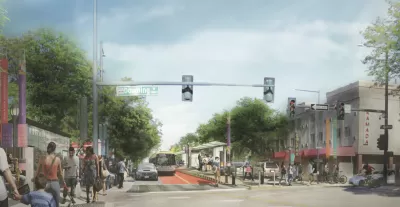
Andrew Kenney reports on the city of Denver's plans for a bus rapid transit (BRT) route on East Colfax Avenue—which will have to wait while the city looks for the money to fill a significant funding gap.
City officials announced this week that the project needs around $150 million in more in funding in addition to the $55 million approved by voters for the project in 2017. However, "[t]he city’s budget took a blow when Colorado voters last year rejected Proposition 110, which could have provided $70 million for BRT in Denver," according to Kenney. The city has only just begun applying federal grants to make up the difference.
"Originally the city hoped to start building within a few years but it now expects the project will take five to eight years to build — and it hasn’t said when that process will start," according to Kenney. "That means East Colfax BRT service wouldn’t begin until 2024 at the very earliest, and likely could be delayed into the late 2020s."
The BRT route is also a potentially significant piece of an ongoing land use planning effort in East Denver—raising the stakes of the unanswered questions about the funding of the plan.

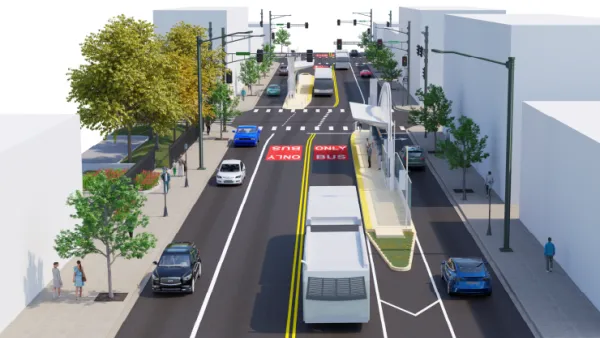
Land Use Changes Could Improve Walkability Along Bus Rapid Transit Corridor in Denver
Denver councilmembers are proposing an overhaul of land use regulations along a long stretch of East Colfax Avenue—the route of a planned Bus Rapid Transit line expected to open in 2026.
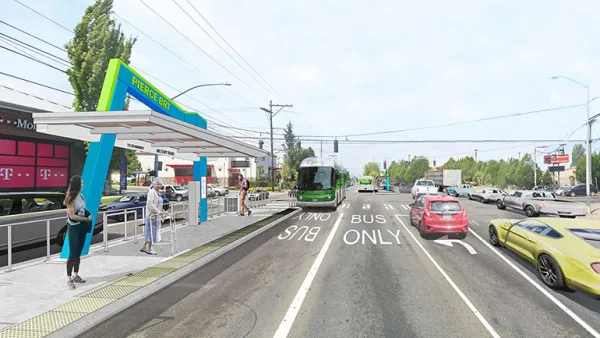
Bus Rapid Transit Plans Scrapped in Tacoma
A planned bus rapid transit (BRT) line known as “Stream” will have to move forward in some new, as-yet-unplanned form in Tacoma, Washington.

Funding for Planned Bus Rapid Transit Routes Survives Scare in the Indiana General Assembly
Despite the temporary victory for transit advocates in Indianapolis, the battle over transit funding continuous in the Indiana General Assembly.

Planetizen Federal Action Tracker
A weekly monitor of how Trump’s orders and actions are impacting planners and planning in America.

California plans to bury El Niño’s downpour
If the state plays its cards right, it may be able to store a billion acre-feet of El Niño’s water in aquifers.

Chicago breaks ground on $3 billion megadevelopment
The new neighborhood, titled Foundry Park, will one day host 3,700 residences.

Satanic Place Names
From streams and lakes to valleys and canyons, I mapped more than 1,000 places named after the Devil.

California High-Speed Rail Authority CEO resigns after $600,000 scandal
Under Ian Choudri, the authority used taxpayer dollars to fund first class flights and trips to nightclubs.

Want to study the Missouri River? Soon, you may need unanimous approval from 10 states
Legislation would require 10 governors’ permission to study or build projects moving water outside the basin.

FREE Course: Walkable City 1: Why Walkability?
After describing his path towards focusing on walkability as the essence of good planning, Jeff Speck marches through his five principal reasons for making more walkable places.
Reinventing Malls: Planning Alchemy—Turning Gray Fields Into Gold
The course focuses on the opportunities and imperatives that shape reinvention of mall sites.

City of Rosemead
Rutgers University, Edward J. Bloustein School of Planning and Public Policy
One Hundred Miles
Hunter College, City University of New York (CUNY)
The Architects Foundation
University of Cincinnati Online
City of Cambridge
Montrose County
The Pocatello Development Authority