A lawsuit has forced New York City to invest significant funds and people power to making the public realm more accessible to people with disabilities.


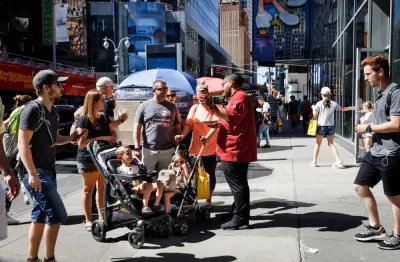
"New York City plans to hire 500 workers and spend $1.55 billion over the next decade to make it easier for people with disabilities to traverse city streets," reports Dana Rubinstein.
The news comes after a federal judge approved a settlement "requiring New York City to dramatically overhaul its curb ramps, most of which do not meet federal accessibility requirements" earlier this week.
Rubintein provides more specifics on the work that will be enacted for the city's new "Pedestrian Ramp Unit":
The settlement approved Tuesday requires the city to survey every single corner in the five boroughs by October 31 using laser technology. The city is required to conduct two subsequent surveys in 2033 and 2046.
All but roughly 3,100 street corners in New York City have pedestrian ramps — themselves the product of prior litigation — but most of them are not up to code. Upgrades of most non-compliant pedestrian ramps will have to be completed by 2034.
James Weisman, the president and CEO of the United Spinal Association and a signatory to the settlement, calls the settlement "historic" in the article.
Read the full story: New York City makes a $1.55B, 500-person commitment to accessible street corners

Report: NYC Transit Accessibility Depends on Congestion Pricing Revenue
The ability of the MTA to complete its accessibility upgrades relies on funding from the upcoming congestion pricing program.
New Guidelines Bring Clarity to Accessibility Requirements
The new rules could help bridge the gaps in accessibility infrastructure and ADA compliance, making roads and sidewalks safer for everyone.
New York Subway Begins Accessibility Improvements
The MTA is putting its effort to improve the system’s century-old stations to make them more universally accessible in high gear, adding elevators, boarding upgrades, and mechanical improvements.

Planetizen Federal Action Tracker
A weekly monitor of how Trump’s orders and actions are impacting planners and planning in America.

The state-sanctioned urbicide of Austin
People don’t kill cities. Freeways do.

US to reduce Colorado River water deliveries to Mexico
A new Colorado Treaty amendment reduces Mexico’s Colorado River water allocation by 250,000 acre feet.

Nation's most wind-powered state turns to coal as data centers increase energy demand
For the first time in decades, Iowa has increased its generation of coal power.

NYC cools commuters with city's first rain garden above a bus stop
New York City officials say the plants in the rain garden can absorb 16 gallons of rainwater during heavy storms.

Brightline West’s future may rely on $6 billion federal loan
The company has until Nov. 2 to make a $400 million equity investment into its proposed high-speed rail line.

FREE Course: Walkable City 1: Why Walkability?
After describing his path towards focusing on walkability as the essence of good planning, Jeff Speck marches through his five principal reasons for making more walkable places.
Reinventing Malls: Planning Alchemy—Turning Gray Fields Into Gold
The course focuses on the opportunities and imperatives that shape reinvention of mall sites.

Greater Baltimore Committee
Eagle County Government
Harvard University Graduate School of Design
The Architects Foundation
University of Cincinnati Online
The Pocatello Development Authority
The Urban Renewal Agency of the City of Pocatello
Journal of the American Planning Association