Following Salesforce's lead, the healthcare giant will relocate to a high-rise urban headquarters, transitioning out of seven locations it currently occupies in the East Bay.



Kaiser Permanente's planned new headquarters will encompass 1.6 million square feet of floor space, making it "one of the largest new buildings in the Bay Area — larger in space, though not height, than San Francisco's Salesforce Tower," Roland Li writes.
The healthcare corporation, already Oakland's largest employer, will consolidate over 7,000 employees from seven locations into the new 29-story tower, which is set to open in 2023. Occupying a site currently graced with "a parking garage and vacant lots," the new headquarters will be dubbed the Kaiser Permanente Thrive Center and cost a total of $900 million, saving the firm $60 million a year compared with its current set-up.
Kaiser's move makes it one of the latest major firms to set up shop downtown, moving away from the suburban office park mode. "The building is comparable in size to the huge suburban buildings occupied by tech giants Facebook and Google in Silicon Valley," Li writes.
Read the full story: Kaiser Permanente to build giant, new $900 million Oakland headquarters

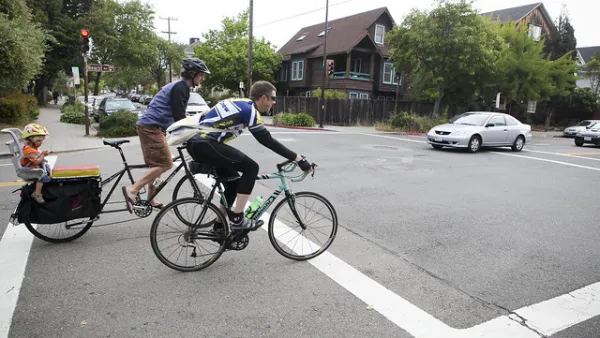
City to Bicyclists: Berkeley Not in Idaho
Berkeley, California might have a reputation of a very progressive city, but when it comes to cycling, it appears to have little tolerance for cyclists who roll through stop signs. Police are justifying the crackdown on the terms of a state grant.
Second Largest Bikeshare in U.S. will be Bay Area's by 2017
Bay Area Bike Share will grow from 700 to 7,000 bikes by 2017 after the expansion proposal was approved by a unanimous vote of the Metropolitan Transportation Commission. It is a regional, not a city program, though most usage is in San Francisco.

Transportation Start-up Fails for Being Too Public-Minded
Night School, planning to use school bus fleets to supplement late-night Bay Area transit, lost the regulatory fights Uber and Lyft handily won.

Planetizen Federal Action Tracker
A weekly monitor of how Trump’s orders and actions are impacting planners and planning in America.

California plans to bury El Niño’s downpour
If the state plays its cards right, it may be able to store a billion acre-feet of El Niño’s water in aquifers.

Chicago breaks ground on $3 billion megadevelopment
The new neighborhood, titled Foundry Park, will one day host 3,700 residences.

Satanic place names
From streams and lakes to valleys and canyons, I mapped more than 1,000 places named after the Devil.

California High-Speed Rail Authority CEO resigns after $600,000 scandal
Under Ian Choudri, the authority used taxpayer dollars to fund first class flights and trips to nightclubs.

Want to study the Missouri River? Soon, you may need unanimous approval from 10 states
Legislation would require 10 governors’ permission to study or build projects moving water outside the basin.

FREE Course: Walkable City 1: Why Walkability?
After describing his path towards focusing on walkability as the essence of good planning, Jeff Speck marches through his five principal reasons for making more walkable places.
Reinventing Malls: Planning Alchemy—Turning Gray Fields Into Gold
The course focuses on the opportunities and imperatives that shape reinvention of mall sites.

City of Rosemead
Rutgers University, Edward J. Bloustein School of Planning and Public Policy
One Hundred Miles
Hunter College, City University of New York (CUNY)
The Architects Foundation
University of Cincinnati Online
City of Cambridge
Montrose County
The Pocatello Development Authority