Housing advocates blame the neglect of the federal government on the state of public housing in the United States. The Trump administration says government can't keep throwing money at the problems of public housing.


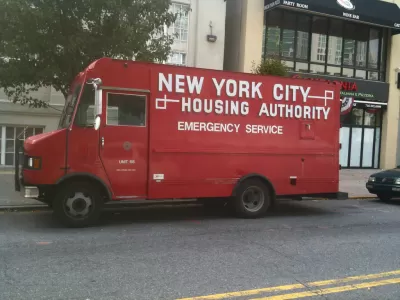
Pam Fessler continues NPR's coverage of the Trump administration's funding of public housing, especially with the fund that pays for repairs to aging public housing facilities around the country.
Public housing officials estimate that it would cost $50 billion to fix living for the 2 million Americans currently living in public housing. "Part of the problem stems from a steady decline in public housing repair funding over the past decade. About $2 billion to $3 billion has been appropriated in recent years, half the amount approved in 2000. At the same time, the needs have grown at a more rapid rate, creating a massive backlog," according to Fessler.
According to previous coverage by Fessler from April 2019 (and Planetizen coverage from March 2019), the Trump administration's draft budget for 2020 proposing cuts to public housing repair funding in addition to eliminating the HOME program and Community Development Block Grants.
Fessler's current coverage reports on the Trump administration's support of the cuts, as explained in recent statement by U.S. Department of Housing and Urban Development Ben Carson to a House appropriations subcommittee, but the bulk of the article is devoted to describing living conditions in public housing units around the country.
FULL STORY: Trump Administration Wants To Cut Funding For Public Housing Repairs


Outrage Over Trump's Fair Housing Victory Lap
President Trump took to Twitter today to celebrate his administration's decision to rescind the Affirmatively Furthering Fair Housing rule, approved by the Obama administration to strengthen the Fair Housing Act of 1968.
White House Report on 'The State of Homelessness in America' Criticized
Shortly after a tumultuous visit to California focusing on the homelessness crisis in San Francisco and Los Angeles, Trump administration has released a report on homelessness that is already facing criticism.
Local Public Housing Agencies Resist HUD's Proposed Section 8 Rule
A proposed rule to disqualify all families living with an undocumented person from receiving federal housing aid is available for comment. We know a few people who oppose the rule.

The state-sanctioned urbicide of Austin
People don’t kill cities. Freeways do.

US to reduce Colorado River water deliveries to Mexico
A new Colorado Treaty amendment reduces Mexico’s Colorado River water allocation by 250,000 acre feet.

New Jersey’s second-largest city bans standalone data centers
Jersey City will continue to allow co-location facilities, such as those meant for research institutions that store their own data.

Amtrak not solely to blame for New Jersey commuter rail's unreliability, report finds
A new study from the Garden State Initiative found that NJ Transit’s budget grew 20% across a 4 year period, but reliability declined significantly over the same period.

EPA erases limits on planet-warming pollution from power plants
Under Monday’s plan, power plants would still have some limits on how much mercury, arsenic and other contaminants they can emit.

Phoenix announces new on-demand transit service, more frequent RAPID buses
Both new services will launch in October, and are part of Phoenix's Project Effective Access Solutions for Easing Congestion.

FREE Course: Walkable City 1: Why Walkability?
After describing his path towards focusing on walkability as the essence of good planning, Jeff Speck marches through his five principal reasons for making more walkable places.
Reinventing Malls: Planning Alchemy—Turning Gray Fields Into Gold
The course focuses on the opportunities and imperatives that shape reinvention of mall sites.

Eagle County Government
Harvard University Graduate School of Design
Nashville Planning Department
The Architects Foundation
University of Cincinnati Online
The Pocatello Development Authority
The Urban Renewal Agency of the City of Pocatello
Journal of the American Planning Association