The Los Angeles plan to build supportive housing for homeless people is lagging and costing much more than anticipated. A new pilot program seeks to overcome these hurdles by soliciting new ideas and strategies from developers.



Los Angeles officials want housing for homeless residents built faster and at a lower cost. The L.A. City Council recently voted to put aside $120 million from Proposition HHH, a $1.2 billion bond to build 10,000 units of supportive housing.
The funds are for a new pilot program that will solicit proposals for 1,000 units of quality housing that can be built quickly and will be cheaper than other projects, which are now costing more than $550,000 per unit, up from $400,000 before the proposition. The program will consider a range of housing options, including prefabs, granny flats, and shared housing.
"In addition to being an experiment in new housing types, the pilot also is a call for ways to bypass the traditional method of financing affordable and homeless supportive housing, which requires developers to assemble grants and loans from local and state programs as a foundation for highly competitive tax credits," reports Doug Smith.
Read the full story: L.A. approves $120 million to encourage building faster, cheaper homeless housing

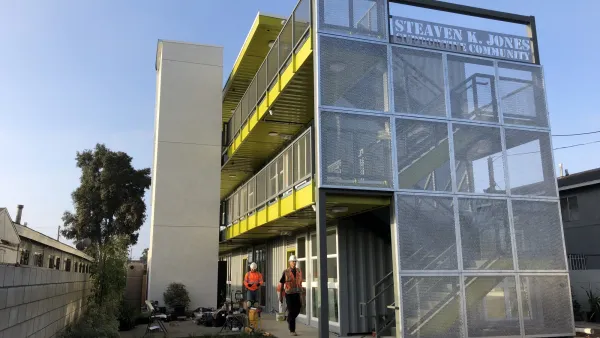
To Reach Goals, L.A. Looks to New Ways to Build Homeless Housing
Los Angeles is grappling with the rising costs of building housing for homeless people. Rethinking the standard process is a way to save time and money.
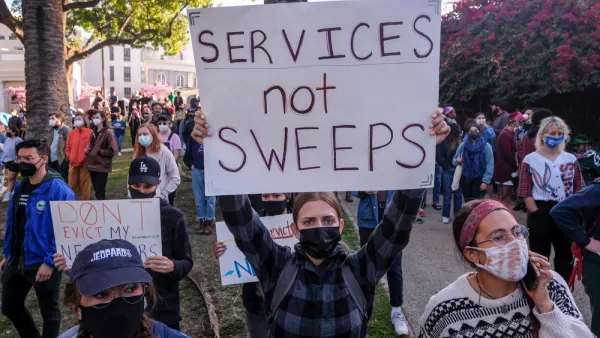
L.A. Shifts Homeless Policy to Clear Street Encampments
Advocates say L.A.'s new focus on clearing 'unsightly' homeless encampments is a political band-aid that won't help people find permanent housing.

Putting a Stop to Disabled-Placard Fraud in L.A.
The fine for misuse of a placard will increase considerably, but not everyone agrees this is the right way to address a growing problem.

Planetizen Federal Action Tracker
A weekly monitor of how Trump’s orders and actions are impacting planners and planning in America.

California plans to bury El Niño’s downpour
If the state plays its cards right, it may be able to store a billion acre-feet of El Niño’s water in aquifers.

Chicago breaks ground on $3 billion megadevelopment
The new neighborhood, titled Foundry Park, will one day host 3,700 residences.

California High-Speed Rail Authority CEO resigns after $600,000 scandal
Under Ian Choudri, the authority used taxpayer dollars to fund first class flights and trips to nightclubs.

Want to study the Missouri River? Soon, you may need unanimous approval from 10 states
Legislation would require 10 governors’ permission to study or build projects moving water outside the basin.

Desperate measures: Advocates weigh draining Lake Powell to fill Colorado River
Draining the reservoir could reduce evaporation losses by a couple hundred thousand acre-feet.

FREE Course: Walkable City 1: Why Walkability?
After describing his path towards focusing on walkability as the essence of good planning, Jeff Speck marches through his five principal reasons for making more walkable places.
Reinventing Malls: Planning Alchemy—Turning Gray Fields Into Gold
The course focuses on the opportunities and imperatives that shape reinvention of mall sites.

City of Rosemead
Rutgers University, Edward J. Bloustein School of Planning and Public Policy
One Hundred Miles
Hunter College, City University of New York (CUNY)
The Architects Foundation
University of Cincinnati Online
City of Cambridge
Montrose County
The Pocatello Development Authority