The latest edition of the annual report by Smart Growth America and the National Complete Streets Coalition reports more and more death and tragedy on American streets and roads.


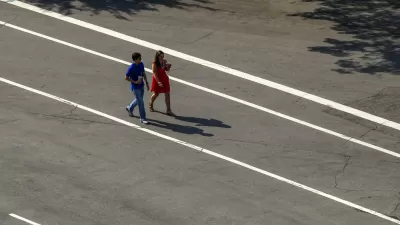
"[T]he number of people struck and killed while walking has grown a startling 35 percent since 2008," according to Laura Bliss, who shares news of the most recent version of the "Dangerous By Design" report for CityLab.
The report cites numerous reasons for the increase in pedestrian fatalities, but singles out one factor in particular: "overly wide arterials that give too much space to cars and too little to humans."
"High-speed, multi-lane avenues that underpin sprawling urban growth, as opposed to slower, narrower streets that support walkable neighborhoods, are 'consistently linked ... to higher rates of both traffic-related deaths for people walking and traffic-related deaths overall,'" writes Bliss, quoting the report's words directly.
FULL STORY: American Roads Are Getting More Dangerous for Pedestrians

4 Proven Steps for Improved Pedestrian Safety
Experts from the National Association of City Transportation Officials (NACTO) present four steps for reducing the number of pedestrians killed by drivers.
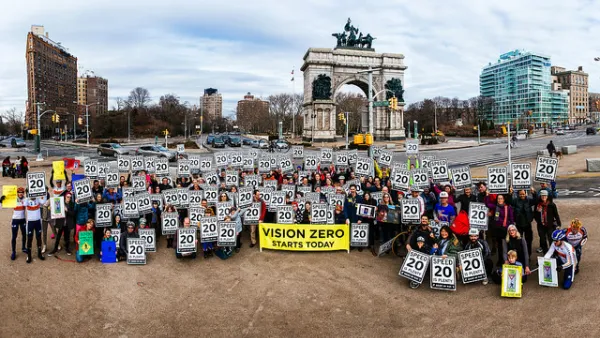
Zero Traffic Deaths Isn't as Far Fetched as It Sounds
Even supporters of Vision Zero—a goal to eliminate traffic fatalities from roadways adopted by cities and states all over the United States—doubt that such lofty ambitions are possible. But there are plenty of reasons to believe in the cause.
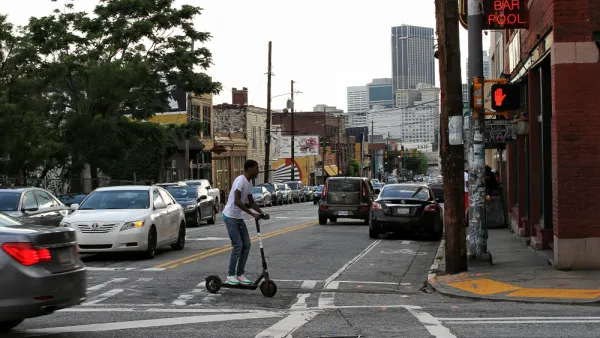
Atlanta Lowers Speed Limits Citywide
Vision Zero arrives in one of the country's most car-centric big cities.

The state-sanctioned urbicide of Austin
People don’t kill cities. Freeways do.

US to reduce Colorado River water deliveries to Mexico
A new Colorado Treaty amendment reduces Mexico’s Colorado River water allocation by 250,000 acre feet.

New Jersey’s second-largest city bans standalone data centers
Jersey City will continue to allow co-location facilities, such as those meant for research institutions that store their own data.

Amtrak not solely to blame for New Jersey commuter rail's unreliability, report finds
A new study from the Garden State Initiative found that NJ Transit’s budget grew 20% across a 4 year period, but reliability declined significantly over the same period.

EPA erases limits on planet-warming pollution from power plants
Under Monday’s plan, power plants would still have some limits on how much mercury, arsenic and other contaminants they can emit.

Phoenix announces new on-demand transit service, more frequent RAPID buses
Both new services will launch in October, and are part of Phoenix's Project Effective Access Solutions for Easing Congestion.

FREE Course: Walkable City 1: Why Walkability?
After describing his path towards focusing on walkability as the essence of good planning, Jeff Speck marches through his five principal reasons for making more walkable places.
Reinventing Malls: Planning Alchemy—Turning Gray Fields Into Gold
The course focuses on the opportunities and imperatives that shape reinvention of mall sites.

Eagle County Government
Harvard University Graduate School of Design
Nashville Planning Department
The Architects Foundation
University of Cincinnati Online
The Pocatello Development Authority
The Urban Renewal Agency of the City of Pocatello
Journal of the American Planning Association