A big feature story celebrates the first ten years of Valley Metro Rail.


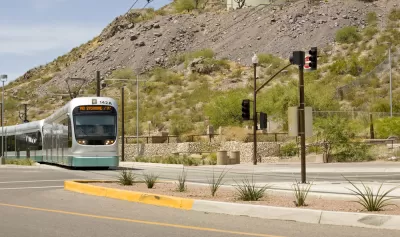
"Ten years ago, on an unusually frosty Phoenix morning, the Valley's most important dignitaries unveiled one of the most expensive and controversial taxpayer-funded projects in Arizona history," according to the lede of a feature article by Jessica Boehm.
The feature includes ten chapters, ranging from an evaluating of system performance to the politics of local support and federal funding. The "mixed results" reported in the article include the following:
- "The rail system almost immediately exceeded its target ridership numbers, and today has an average weekday ridership of about 50,000, a number Valley Metro didn't expect to reach until 2020."
- "Valley Metro estimates $11 billion in private and public investment has sprouted within a half mile of the light-rail line since 2008."
According to Boehm, political forces are coalescing in the city to block any additional expansion of the system, despite dedicated tax revenue devoted to capital investments.
The article includes a lot more history and assessments of the present and future of light rail in Phoenix.
FULL STORY: 10 years and $2B later, what is the future of light rail in metro Phoenix?

Light Rail Plans Survive Election Challenge in Phoenix
An election to decide the fate of public transit planning in the city of Phoenix captured national attention as a bellwether for public opinion. Unofficial results have public transit winning with plenty of votes to spare.
As Phoenix Light Rail Extension Debate Devolves, Questions About Funding
Transit advocates are saying the Koch Brothers are responsible for a sudden outbreak of controversy surrounding the South Central Light Rail Extension in Phoenix.
Phoenix Nixes Light Rail Plans, Shifts Focus to Expanding Transit in West Phoenix
The city is shelving plans for a proposed light rail expansion, opting instead to explore other alternatives for bringing rapid transit to West Phoenix.

The state-sanctioned urbicide of Austin
People don’t kill cities. Freeways do.

US to reduce Colorado River water deliveries to Mexico
A new Colorado Treaty amendment reduces Mexico’s Colorado River water allocation by 250,000 acre feet.

New Jersey’s second-largest city bans standalone data centers
Jersey City will continue to allow co-location facilities, such as those meant for research institutions that store their own data.

Amtrak not solely to blame for New Jersey commuter rail's unreliability, report finds
A new study from the Garden State Initiative found that NJ Transit’s budget grew 20% across a 4 year period, but reliability declined significantly over the same period.

EPA erases limits on planet-warming pollution from power plants
Under Monday’s plan, power plants would still have some limits on how much mercury, arsenic and other contaminants they can emit.

Phoenix announces new on-demand transit service, more frequent RAPID buses
Both new services will launch in October, and are part of Phoenix's Project Effective Access Solutions for Easing Congestion.

FREE Course: Walkable City 1: Why Walkability?
After describing his path towards focusing on walkability as the essence of good planning, Jeff Speck marches through his five principal reasons for making more walkable places.
Reinventing Malls: Planning Alchemy—Turning Gray Fields Into Gold
The course focuses on the opportunities and imperatives that shape reinvention of mall sites.

Eagle County Government
Harvard University Graduate School of Design
Nashville Planning Department
The Architects Foundation
University of Cincinnati Online
The Pocatello Development Authority
The Urban Renewal Agency of the City of Pocatello
Journal of the American Planning Association