As universities become a universally accepted and celebrated economic development power, there's still work to be done in getting the town and gown relationship on the same page.


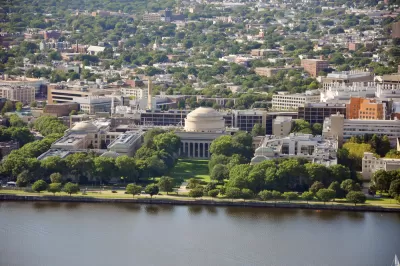
James McCown provides a dispatch from a Think Tank discussion at SmithGroup in Boston, led by Susan S. Szenasy, director of design innovation at Metropolis.
The subject of the discussion was the evolution of the town and gown relationship in cities around the county and the world. Gone are the days of the "tacit agreement" between cities and universities "to get along while mainly remaining isolated from each other."
"Now, almost universally, colleges and universities are thought of as engines of economic growth for both their host cities and regions," writes McCown. "Both encourage a porous interdependence and academic/private partnerships. The nature and manifestation of this interaction can be controversial—despite the economic benefits, some don’t like free-enterprise real estate developers encroaching on what they see as sacred academic ground."
McCown provides a description of key points made by each of the panelists about how to make the town and gown relationship work for the prosperity of the entire community.
Read the full story: As Universities Become More Urban, Campus Planning Is Evolving

Everything you Need to Know from the APA’s 2026 Trend Report for Planners
Plus, a conversation with the APA’s Chief Foresight and Knowledge Officer, Petra Hurtado.
Will Urban Planners Lose Their Jobs to AI?
Let’s see what the data says.

Planning Year in Review 2023: Zoning Reform, a Rail Revolution, and Climate Realities
Last year’s most talked-about planning issues and news.

Planetizen Federal Action Tracker
A weekly monitor of how Trump’s orders and actions are impacting planners and planning in America.

California plans to bury El Niño’s downpour
If the state plays its cards right, it may be able to store a billion acre-feet of El Niño’s water in aquifers.

Desperate measures: Advocates weigh draining Lake Powell to fill Colorado River
Draining the reservoir could reduce evaporation losses by a couple hundred thousand acre-feet.

Mamdani’s pied-à-terre tax survives legal challenge
A panel of judges found that the plaintiffs failed to demonstrate injury as a result of New York City's implementation of the tax.

Eastern Nebraska is running out of electricity
Data centers and electrification are straining eastern Nebraska’s grid, throttling economic development.

Seattle passes record-breaking transit services expansion
Proposition 1 will double the city’s transit tax to add 95,000 more bus trips and preserve 180,000 bus trips annually.

FREE Course: Walkable City 1: Why Walkability?
After describing his path towards focusing on walkability as the essence of good planning, Jeff Speck marches through his five principal reasons for making more walkable places.
Reinventing Malls: Planning Alchemy—Turning Gray Fields Into Gold
The course focuses on the opportunities and imperatives that shape reinvention of mall sites.

City of Rosemead
Rutgers University, Edward J. Bloustein School of Planning and Public Policy
One Hundred Miles
University of Michigan School for Environment and Sustainability (SEAS)
Hunter College, City University of New York (CUNY)
The Architects Foundation
City of Cambridge
Montrose County
The Pocatello Development Authority