Transit writer Alon Levy argues it will take more than system improvements to integrate public transit into L.A.'s urban fabric.


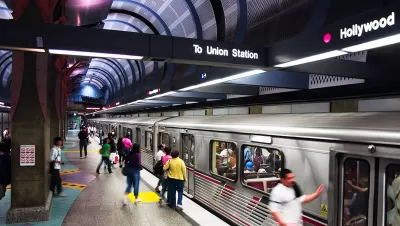
In a post on his blog Pedestrian Observations, Alon Levy explores the peculiar truth that Los Angeles is technically denser than New York, yet is still sprawling, car-centric, and difficult to serve with public transit.
Los Angeles is currently in the midst of a $120 billion expansion of its rail system, as well as a full redesign of its bus network. But Levy argues that to create comprehensive public transit, the city also needs to revise its approach to land use and urban design. After a deep dive comparing statistics on transit ridership, housing density, and job concentration in cities around the world, Levy concludes that the problem facing Los Angeles is where its density is located.
"In Los Angeles, there is no structure to density. There are some missing middle and mid-rise neighborhoods, but few form contiguous blobs of high density that can be served by a rapid transit line … Its dense areas are too far away from one another and from job centers.
... In Los Angeles there is exactly one way out: fix the urban design, and reinforce it with a strong rail network."
FULL STORY: Meme Weeding: Los Angeles Density


How Los Angeles Can Design for Density
Good urban design can make growth more appealing.
Three Things the Mayor Can Do to Fix L.A.
Los Angeles Times architecture critic Christopher Hawthorne offers three pieces of advice to recently re-elected L.A. Mayor Antonio Villaraigosa for improving his city -- and his urban planning credibility.
Move over, zoning. Housing’s unsung hero is better street design.
The physical layout of infrastructure is the quiet force that shapes housing supply.

The state-sanctioned urbicide of Austin
People don’t kill cities. Freeways do.

US to reduce Colorado River water deliveries to Mexico
A new Colorado Treaty amendment reduces Mexico’s Colorado River water allocation by 250,000 acre feet.

New Jersey’s second-largest city bans standalone data centers
Jersey City will continue to allow co-location facilities, such as those meant for research institutions that store their own data.

Amtrak not solely to blame for New Jersey commuter rail's unreliability, report finds
A new study from the Garden State Initiative found that NJ Transit’s budget grew 20% across a 4 year period, but reliability declined significantly over the same period.

EPA erases limits on planet-warming pollution from power plants
Under Monday’s plan, power plants would still have some limits on how much mercury, arsenic and other contaminants they can emit.

Phoenix announces new on-demand transit service, more frequent RAPID buses
Both new services will launch in October, and are part of Phoenix's Project Effective Access Solutions for Easing Congestion.

FREE Course: Walkable City 1: Why Walkability?
After describing his path towards focusing on walkability as the essence of good planning, Jeff Speck marches through his five principal reasons for making more walkable places.
Reinventing Malls: Planning Alchemy—Turning Gray Fields Into Gold
The course focuses on the opportunities and imperatives that shape reinvention of mall sites.

Eagle County Government
Harvard University Graduate School of Design
Nashville Planning Department
The Architects Foundation
University of Cincinnati Online
The Pocatello Development Authority
The Urban Renewal Agency of the City of Pocatello
Journal of the American Planning Association