First, a snow day delayed the opening of the Loop Trolley in St. Louis. Then, the trolley didn't runt the full route. Finally, the trolley line became a crime scene.


"The Loop Trolley got off to a slow start Friday afternoon," reports Mark Schlinkmann.
First, the trolley's originally planned opening, scheduled for Thursday, had to be postponed due to snow.
Then, "[t]he trolley system's two cars only traveled along part of the route in St. Louis, between the Missouri History Museum in Forest Park and a stop at the corner of Delmar Boulevard and Des Peres Avenue." According to Schlinkmann, service was limited due to "glitch" with the conditional use permit issued by University City.
That was a prelude, however, to gunfire near the trolley after a car crash. "Crime scene tape blocked the trolley route as officers investigated the shooting," according to Schlinkmann.
The article includes more details about why University City isn't ready to let the trolley roll over its entire route. Apparently, "there are nine issues that the trolley operators have known about for a year or more that still must be addressed."
FULL STORY: Loop Trolley's first day: A 'bureaucratic snafu' kept it from running full route. Then, crime scene tape.

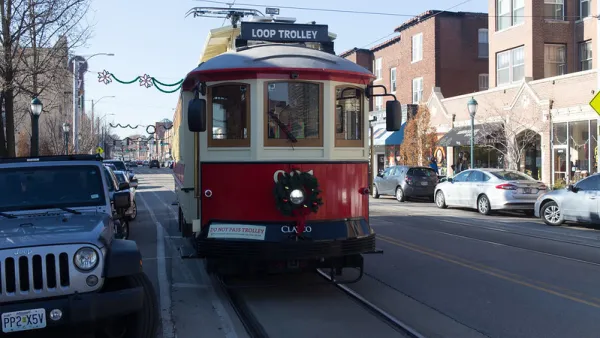
Loop Trolley on the Ropes in St. Louis
Extremely poor ridership might be dooming the St. Louis Loop Trolley less than a year after it opened to the public.
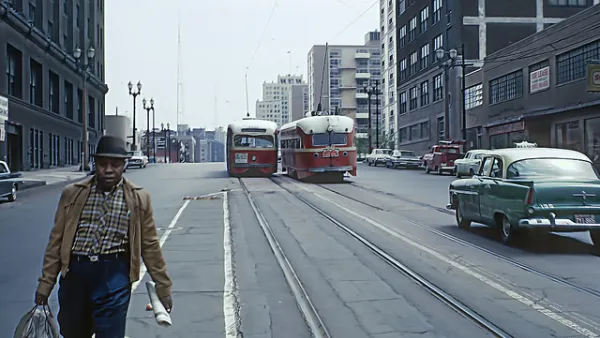
St. Louis Trolley Plans Hit a Snag
The St. Louis trolley revival is running out of cash.
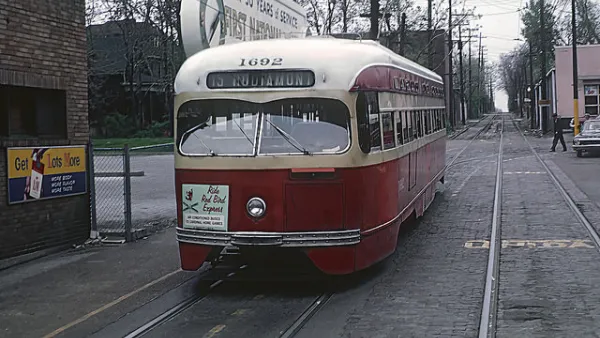
St. Louis Trolley Hoping to Increase Hours
The St. Louis Trolley should begin operating later this year, but planners are hoping for additional funding to allow the service to operate longer hours.

Planetizen Federal Action Tracker
A weekly monitor of how Trump’s orders and actions are impacting planners and planning in America.

The state-sanctioned urbicide of Austin
People don’t kill cities. Freeways do.

US to reduce Colorado River water deliveries to Mexico
A new Colorado Treaty amendment reduces Mexico’s Colorado River water allocation by 250,000 acre feet.

5 New England states march closer to 800 megawatt wind energy project
Securing federal approval for the project may be complicated under the Trump administration, which has historically been hostile towards domestic wind power.

Baltimore to break ground on $50 million Transit Priority Project
The project will bring faster bus trips, safer streets and better bike connections to Baltimore.

Airbnb launches $250 million 'last-dollar financing' housing accelerator, makes first investment in Austin
The company will put $6.4 million towards affordable housing development in Texas’ capital.

FREE Course: Walkable City 1: Why Walkability?
After describing his path towards focusing on walkability as the essence of good planning, Jeff Speck marches through his five principal reasons for making more walkable places.
Reinventing Malls: Planning Alchemy—Turning Gray Fields Into Gold
The course focuses on the opportunities and imperatives that shape reinvention of mall sites.


Eagle County Government
Harvard University Graduate School of Design
Nashville Planning Department
The Architects Foundation
University of Cincinnati Online
The Pocatello Development Authority
The Urban Renewal Agency of the City of Pocatello
Journal of the American Planning Association