The first light rail line to extend beyond Los Angeles County into the Inland Empire has had to rethink its construction schedule in response to skyrocketing costs.


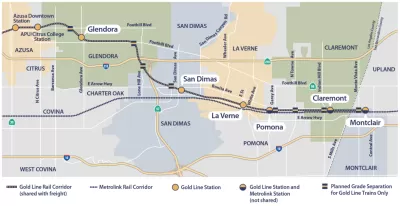
"Citing tariffs on imported steel, tighter immigration policies and rising wages, the Gold Line Construction Authority board Tuesday voted to build only half the Glendora-to-Montclair extension, saying runaway construction costs could prevent building out to Montclair," reports Steve Scauzillo.
"By a 5-0 unanimous vote, the board authorized the surprise staff recommendation that the 12.3-mile extension needs to be built in two phases due to costs rising 38 percent, from $1.5 billion to $2.1 billion," adds Scauzillo.
The new phased approach to construction means that the first eight miles of the extension, with stations in Glendora, San Dimas, and La Verne, will be complete in 2024, two years earlier than planned.
Scauzillo provides a lot more detail on the project and the Gold Line Construction Authority's reaction to the challenges facing the project. Steven Sharp provides additional analysis in a separate article.
FULL STORY: Gold Line extension delayed because of steel tariffs, runaway construction costs, authority says

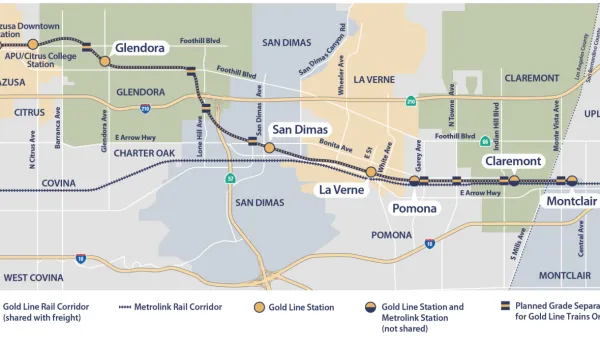
Light Rail Extension Into the Inland Empire Faces Growing Opposition
The plan for the Gold Line Extension to Montclair in San Bernardino County has changed quickly. Now some want to throw out the idea completely.

New Bus Priority Lane Under Construction in Los Angeles
La Brea Avenue will soon gain a new bus priority lane, with plans for more to come still gathering community feedback.
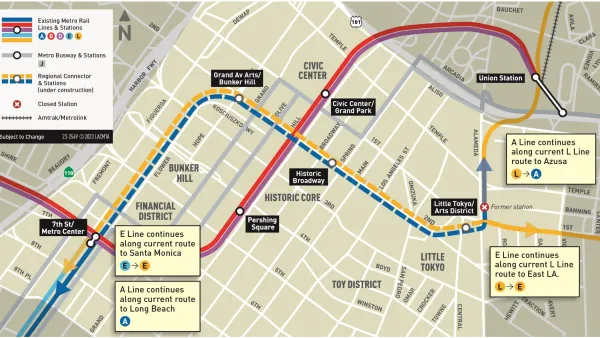
Newly Opened Regional Connector Redefines Light Rail Transit in Los Angeles
Three rail lines have become two rail lines in Los Angeles, providing one-seat rides from four corners of Los Angeles County.

Planetizen Federal Action Tracker
A weekly monitor of how Trump’s orders and actions are impacting planners and planning in America.

The state-sanctioned urbicide of Austin
People don’t kill cities. Freeways do.

US to reduce Colorado River water deliveries to Mexico
A new Colorado Treaty amendment reduces Mexico’s Colorado River water allocation by 250,000 acre feet.

5 New England states march closer to 800 megawatt wind energy project
Securing federal approval for the project may be complicated under the Trump administration, which has historically been hostile towards domestic wind power.

Baltimore to break ground on $50 million Transit Priority Project
The project will bring faster bus trips, safer streets and better bike connections to Baltimore.

Airbnb launches $250 million 'last-dollar financing' housing accelerator, makes first investment in Austin
The company will put $6.4 million towards affordable housing development in Texas’ capital.

FREE Course: Walkable City 1: Why Walkability?
After describing his path towards focusing on walkability as the essence of good planning, Jeff Speck marches through his five principal reasons for making more walkable places.
Reinventing Malls: Planning Alchemy—Turning Gray Fields Into Gold
The course focuses on the opportunities and imperatives that shape reinvention of mall sites.

Eagle County Government
Harvard University Graduate School of Design
Nashville Planning Department
The Architects Foundation
University of Cincinnati Online
The Pocatello Development Authority
The Urban Renewal Agency of the City of Pocatello
Journal of the American Planning Association