The ability of Paris Mayor Anne Hidalgo to ban cars from the Seine Quays was at stake.


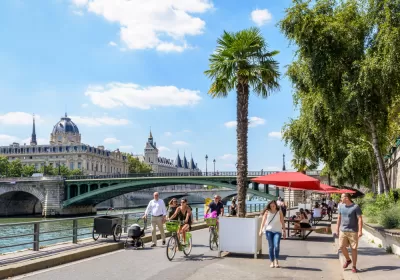
Paris' Administrative Court has ruled to uphold a pedestrianization plan for the Seine Quays—a signature air pollution and transportation policy of Mayor Anne Hidalgo.
Feargus O'Sullivan reports on the decision, and shares insights about the stakes at play in the outcome:
The pedestrianization plan, a flagship policy of Mayor Anne Hidalgo’s green overhaul of France’s capital, has been in jeopardy for months after opponents, who included motorists’ groups and representatives of suburban districts surrounding the city, got a court to agree in February that the closure had been based on inaccurate evidence about pollution and traffic reduction.
Today’s rejection of that complaint is thus a major victory for Paris City Hall and has even drawn expressions of relief from members of the opposition party, which welcomed an end to what it called a legal “soap opera.” It must also be a relief for Hidalgo, who filmed a personal message celebrating the ruling. Indeed, news magazine L’Obs has hypothesized that City Hall’s reaction is no less than “un grand ‘ouf’”—“a big ‘phew.’”
While the car restrictions enacted by Mayor Hidalgo have been unequivocally praised by urbanists in the United States, the issue is far more complex in Paris and surrounding communities. "Indeed, reports in newspaper Le Parisien yesterday suggest that while cars and their pollution may have been displaced from the pedestrianized lower quayside, they had not in fact reduced in the surrounding area or across the city as a whole," according to O'Sullivan.
Read the full story: Paris Gets to Keep Its Car Ban

French Suburbs Join Paris in Diesel Ban
The ban on diesel cars now extends well beyond the city of Paris.
Paris to Begin Serious Car Restrictions on July 1
The carefree days of driving any-old-junker-they-please are over for Parisians, and they'll be even further obsolete when the calendar changes from June to July.
Car-Free Movement Gaining Steam in Europe and Elsewhere
Athlyn Cathcart-Keays of The Guardian-Cities chronicles the advancement of the international urban car-free movement as well as auto regulations that focus on air pollution. The most recent city to join the growing list is Oslo, Norway

Planetizen Federal Action Tracker
A weekly monitor of how Trump’s orders and actions are impacting planners and planning in America.

California plans to bury El Niño’s downpour
If the state plays its cards right, it may be able to store a billion acre-feet of El Niño’s water in aquifers.

Desperate measures: Advocates weigh draining Lake Powell to fill Colorado River
Draining the reservoir could reduce evaporation losses by a couple hundred thousand acre-feet.

California city breaks ground on transit connector
The project includes three mobility hubs and a pedestrian bridge.

After public outcry, Massachusetts city releases housing development tracker
Cambridge’s tracker currently shows 250 housing projects in various stages of development.

40 years after approval, Chicago breaks ground on new park
The park honors Jean Baptiste Point du Sable, the city’s first permanent non-native settler.

FREE Course: Walkable City 1: Why Walkability?
After describing his path towards focusing on walkability as the essence of good planning, Jeff Speck marches through his five principal reasons for making more walkable places.
Reinventing Malls: Planning Alchemy—Turning Gray Fields Into Gold
The course focuses on the opportunities and imperatives that shape reinvention of mall sites.

City of Rosemead
Rutgers University, Edward J. Bloustein School of Planning and Public Policy
One Hundred Miles
Hunter College, City University of New York (CUNY)
The Architects Foundation
University of Cincinnati Online
City of Cambridge
Montrose County
The Pocatello Development Authority