80 Flatbush has been one of the most closely watched, and hotly debated, proposed developments in the country.



"The New York City Council’s subcommittee on zoning and franchises voted to approve 80 Flatbush, which will rise on a triangular lot at the intersection of Downtown Brooklyn and Boerum Hill," report Amy Plitt and Tanay Warerkar.
The decision makes it more certain that the controversial development will receive support from the full New York City Council later this month, according to the article.
With the approval came compromise, however. "The developers agreed to reduce the floor area ratio (FAR) from 18—which would have made it one of the city’s most dense projects—to 15.75; they also agreed to shave some height from the two skyscrapers that will dominate the development," according to Plitt and Warerkar. "A proposed 986-foot supertall will now stand 840 feet, and the second tower will shrink from 560 to 510 feet."
Previous Planetizen coverage of 80 Flatbush:
FULL STORY: Brooklyn’s 80 Flatbush gets crucial City Council committee approval

New York's Economy Is Going Strong. Can it Build Fast Enough to Keep Up?
If Brooklyn keeps up the pace of current growth, it could pass Chicago in population in the next few years.
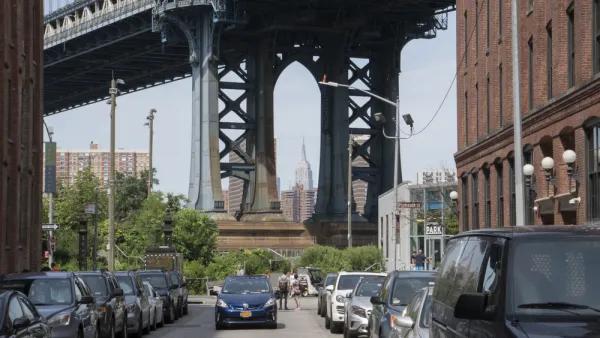
‘Instagrammed to Death’ or a Return to Pre-Pandemic Normal?
Familiar controversies might seem reassuring in 2022.

Gowanus Rezoning Clears Post-Approval Legal Hurdle
The saga of the Gowanus Neighborhood Planning Study, approved by New York City at the end of 2021, continues into the summer of 2022. Opponents claimed the Gowanus rezoning ran afoul of the state’s environment law. A county judge dismissed the case.

The state-sanctioned urbicide of Austin
People don’t kill cities. Freeways do.

US to reduce Colorado River water deliveries to Mexico
A new Colorado Treaty amendment reduces Mexico’s Colorado River water allocation by 250,000 acre feet.

New Jersey’s second-largest city bans standalone data centers
Jersey City will continue to allow co-location facilities, such as those meant for research institutions that store their own data.

Amtrak not solely to blame for New Jersey commuter rail's unreliability, report finds
A new study from the Garden State Initiative found that NJ Transit’s budget grew 20% across a 4 year period, but reliability declined significantly over the same period.

EPA erases limits on planet-warming pollution from power plants
Under Monday’s plan, power plants would still have some limits on how much mercury, arsenic and other contaminants they can emit.

Phoenix announces new on-demand transit service, more frequent RAPID buses
Both new services will launch in October, and are part of Phoenix's Project Effective Access Solutions for Easing Congestion.

FREE Course: Walkable City 1: Why Walkability?
After describing his path towards focusing on walkability as the essence of good planning, Jeff Speck marches through his five principal reasons for making more walkable places.
Reinventing Malls: Planning Alchemy—Turning Gray Fields Into Gold
The course focuses on the opportunities and imperatives that shape reinvention of mall sites.

Eagle County Government
Harvard University Graduate School of Design
Nashville Planning Department
The Architects Foundation
University of Cincinnati Online
The Pocatello Development Authority
The Urban Renewal Agency of the City of Pocatello
Journal of the American Planning Association