Scientists say the Chesapeake Bay hasn't been this healthy in more than three decades. It's a testament to federal environmental regulations.



"In sharp contrast to the days when the [Chesapeake Bay] was so beleaguered that every meaningful species experienced sharp population declines, officials and scientists from the District, Maryland and Virginia announced Friday that it is in the midst of a full and remarkable recovery," reports Darryl Fears.
Fears surveys the improvements—some regions of the bay are improving quicker than others, before giving credit to a 15-year, $19 billion cleanup plan administered by the Environmental Protection Agency. The plan limits pollution levels in six states and the District of Columbia.
Under the plan, which President Barack Obama mandated in 2010 through an executive order, Virginia, Maryland, Delaware, West Virginia, Pennsylvania and New York, along with the District, agreed to substantially improve wastewater treatment facilities and decrease runoff from farms once responsible for significant amounts of waste reaching the rivers and streams that run into the bay.
The bay's report card now earns a C, with some areas, like water clarity, still earning an F. "But the James River area and the lower stem of the bay closer to the Atlantic both earned grades of at least B-, their highest ever, and shored up the overall score," according to Fears.
Read the full story: The Chesapeake Bay hasn’t been this healthy in 33 years, scientists say


Will the Supreme Court’s Chevron Decision Impact Environmental Regulations?
By overturning the Chevron doctrine, the Supreme Court stripped federal agencies like the EPA of final say when interpreting ambiguous legislative policies, leaving future decisions up to judges.

Undoing Biden's EV Rule
The partisan divide over how government should reduce greenhouse gas emissions was on full display after the Biden administration finalized its emissions standards rule for light and medium duty vehicles on March 20.
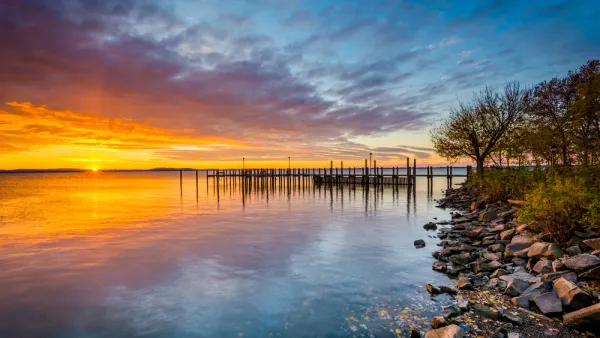
Federal Protection Proposed for Chesapeake Bay
Two Maryland lawmakers will introduce legislation to create the Chesapeake Bay National Recreation Area to protect the region’s important ecological and cultural resources.

Planetizen Federal Action Tracker
A weekly monitor of how Trump’s orders and actions are impacting planners and planning in America.

Amtrak, CN end decades-long dispute with eight-year agreement
The new operating agreement establishes an updated framework for the companies to work together, including processes to resolve disputes.

Judges permit Denver to divert 77,000 acre feet from the Colorado River for reservoir expansion
Overuse and climate change have caused the Colorado River’s water levels to plummet.

NYC DOT wants faster, more permanent street upgrades
The city is examining ways to build more concrete infrastructure without getting entangled in 'decades-long' projects.

'Something we’ve never seen before:' rising utility rates could strain city finances nationwide
Data centers, climate change and other factors have caused utility rates in the United States to increase by 38% since 2020.

Trump to overrule local leaders, lease millions of acres of America’s Pacific Island territories’ seafloors to mining companies
International law says that the Indigenous people of America’s territories have a right to prior and informed consent regarding projects that impact their countries.

FREE Course: Walkable City 1: Why Walkability?
After describing his path towards focusing on walkability as the essence of good planning, Jeff Speck marches through his five principal reasons for making more walkable places.
Reinventing Malls: Planning Alchemy—Turning Gray Fields Into Gold
The course focuses on the opportunities and imperatives that shape reinvention of mall sites.

Harvard University Graduate School of Design
KFH Group Inc.
Greater Baltimore Committee
The Architects Foundation
University of Cincinnati Online
The Pocatello Development Authority
The Urban Renewal Agency of the City of Pocatello