The new City Health Dashboard might be the first time many communities have had access to a treasure trove of public health data at the click of a mouse button.



Robin B. Schaz shares news of a new online "City Health Dashboard" that shares and illustrates public health data—both outcomes and drivers—for 500 U.S. cities.
"The City Health Dashboard, developed by NYU Langone Medical Center and the Robert F. Wagner School of Public Service at NYU, features both city- and neighborhood-level data," according to Schaz. Metrics are broken into categories for Social and Economic factors, Physical Environment, Health Behaviors, Health Outcomes, and Clinical Care. In addition to city-level and Census tract data, the platform also includes information on demographic groups.
"The health dashboard originally launched in January as a pilot in Flint, Mich.; Kansas City, Kan.; Providence, R.I.; and Waco, Texas, according to Schaz. "The tool has since expanded nationwide with a $3.4 million grant from the Robert Wood Johnson Foundation."
Read the full story: New online tool shows how New Yorkers fare on health metrics


Harnessing Data for Community Development
Using data and insights encourages the development of a community, offering an evidence-based strategy to directly address the needs within.
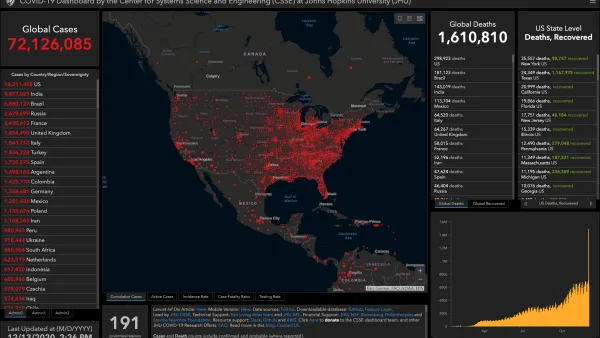
How Mapping Tools Played a Role in Understanding COVID-19
A new episode of the Geospatial Revolution Project assesses how scientists used digital mapping tools to think about the pandemic.

Pandemic Data for Planners
The right data will be critical in crafting effective responses to the threats posed by the coronavirus.

Planetizen Federal Action Tracker
A weekly monitor of how Trump’s orders and actions are impacting planners and planning in America.

The state-sanctioned urbicide of Austin
People don’t kill cities. Freeways do.

US to reduce Colorado River water deliveries to Mexico
A new Colorado Treaty amendment reduces Mexico’s Colorado River water allocation by 250,000 acre feet.

Nation's most wind-powered state turns to coal as data centers increase energy demand
For the first time in decades, Iowa has increased its generation of coal power.

NYC cools commuters with city's first rain garden above a bus stop
New York City officials say the plants in the rain garden can absorb 16 gallons of rainwater during heavy storms.

Brightline West’s future may rely on $6 billion federal loan
The company has until Nov. 2 to make a $400 million equity investment into its proposed high-speed rail line.

FREE Course: Walkable City 1: Why Walkability?
After describing his path towards focusing on walkability as the essence of good planning, Jeff Speck marches through his five principal reasons for making more walkable places.
Reinventing Malls: Planning Alchemy—Turning Gray Fields Into Gold
The course focuses on the opportunities and imperatives that shape reinvention of mall sites.

Greater Baltimore Committee
Eagle County Government
Harvard University Graduate School of Design
The Architects Foundation
University of Cincinnati Online
The Pocatello Development Authority
The Urban Renewal Agency of the City of Pocatello
Journal of the American Planning Association