It's still early in the planning process, but an Automated People Mover could eventually replace buses and shuttles as the airport connection of choice for Logan International Airport.


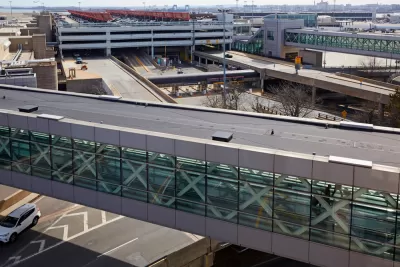
"Seeking to reduce road traffic, officials at Logan International Airport will spend $15 million to design and study the feasibility of a transit line that would ferry travelers to and from terminals, the MBTA’s Blue Line, economy parking lots, and the car rental center," reports Adam Vaccaro.
The Massachusetts Port Authority planning is planning to hire a consultant to launch the process, which was originally dreamed up in 2015 but is obviously still very preliminary and speculative. Officials estimate the project could take as 10 years and $1 billion to complete.
Boston could follow in the footsteps of Los Angeles, which recently finalized plans for an Automated People Mover of its own, as detailed in an article by Laura J. Nelson.
Read the full story: Automatic for the people: Logan to study if a train (or monorail) should replace shuttles at the airport

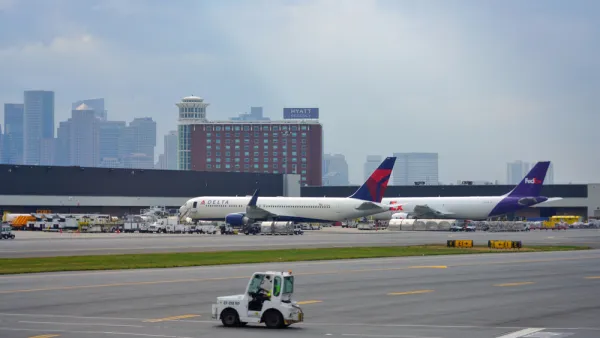
Flight Path Changes Raise Hell Around Logan International Airport
A resident in Medford counted 110 planes flying above his house in the span of six hours.
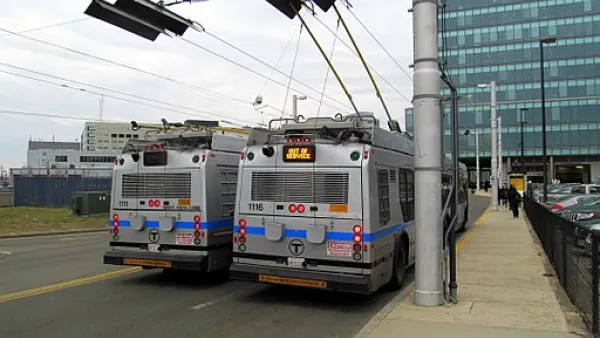
Boston Needs Buses, Not Gondolas
A CommonWealth Magazine editorial argues that gondolas over Summer Street in Boston's Seaport district are less practical than busses, which could avoid traffic with a dedicated lanes.
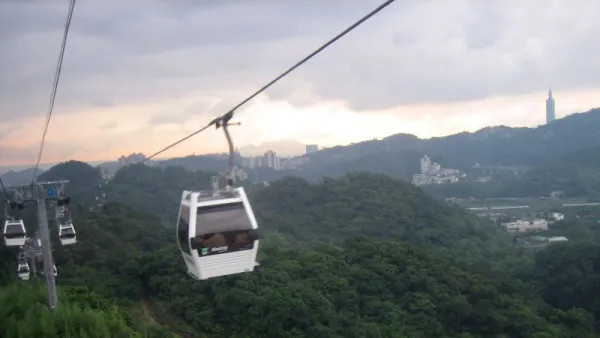
Gondolas Proposed for Boston's Seaport District
Boston's Seaport District has grown rapidly, and traffic is an ongoing concern. Developers have proposed an interesting solution: aerial trams.

Planetizen Federal Action Tracker
A weekly monitor of how Trump’s orders and actions are impacting planners and planning in America.

California plans to bury El Niño’s downpour
If the state plays its cards right, it may be able to store a billion acre-feet of El Niño’s water in aquifers.

Chicago breaks ground on $3 billion megadevelopment
The new neighborhood, titled Foundry Park, will one day host 3,700 residences.

California High-Speed Rail Authority CEO resigns after $600,000 scandal
Under Ian Choudri, the authority used taxpayer dollars to fund first class flights and trips to nightclubs.

Want to study the Missouri River? Soon, you may need unanimous approval from 10 states
Legislation would require 10 governors’ permission to study or build projects moving water outside the basin.

Desperate measures: Advocates weigh draining Lake Powell to fill Colorado River
Draining the reservoir could reduce evaporation losses by a couple hundred thousand acre-feet.

FREE Course: Walkable City 1: Why Walkability?
After describing his path towards focusing on walkability as the essence of good planning, Jeff Speck marches through his five principal reasons for making more walkable places.
Reinventing Malls: Planning Alchemy—Turning Gray Fields Into Gold
The course focuses on the opportunities and imperatives that shape reinvention of mall sites.

City of Rosemead
Rutgers University, Edward J. Bloustein School of Planning and Public Policy
One Hundred Miles
Hunter College, City University of New York (CUNY)
The Architects Foundation
University of Cincinnati Online
City of Cambridge
Montrose County
The Pocatello Development Authority