Boston's Seaport District has grown rapidly, and traffic is an ongoing concern. Developers have proposed an interesting solution: aerial trams.


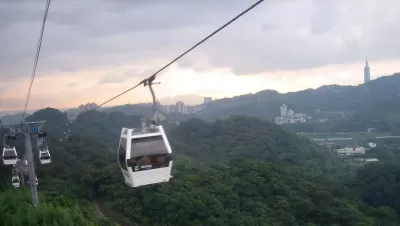
Gondola proposals have been floated in a number of cities recently, including Washington, D.C. and Los Angeles. Here's one more. To ease the booming district's traffic, Jon Chesto writes, "Millennium Partners and Cargo Ventures envision a 1-mile gondola system running above Summer Street to provide transportation between South Station and 12 acres they plan to develop in the city's marine industrial park."
Democratic Representative Stephen Lynch, who has promoted the project, stated that "This gondola system would carry the equivalent of 40 buses per hour, while reducing vehicular traffic and eliminating carbon emissions."
While Millennium Partners is willing to pay the requisite $100 million, "neither the city of Boston nor the Massachusetts Port Authority, a major landowner in the neighborhood, have expressed support for [the project]."
"Among the city officials' concerns are the gondola system's aesthetics as well as potential conflicts with other transportation options under consideration, such as dedicated bus lanes along Summer Street," writes Chesto. And then there's the larger question: are gondolas just an eye-catching distraction?
FULL STORY: Could a gondola system be coming to Boston’s Seaport District?

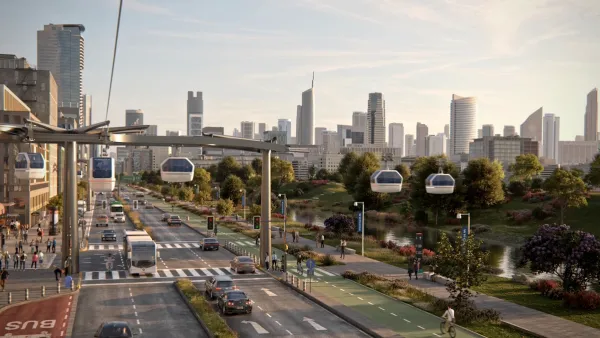
Anaheim Proposes Gondola Connecting Disneyland, Stadiums, Transit Center
The as-yet-unfunded project would connect major attractions along the city’s main artery.
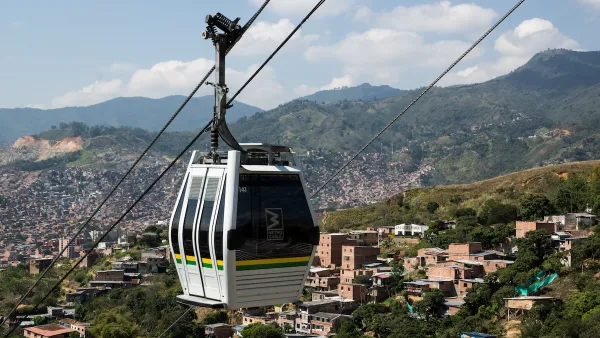
In U.S., Urban Gondolas Face Uphill Battle
Cities in Latin America and Europe have embraced aerial transitways — AKA gondolas — as sustainable, convenient urban transport, especially in tricky geographies. American cities have yet to catch up.
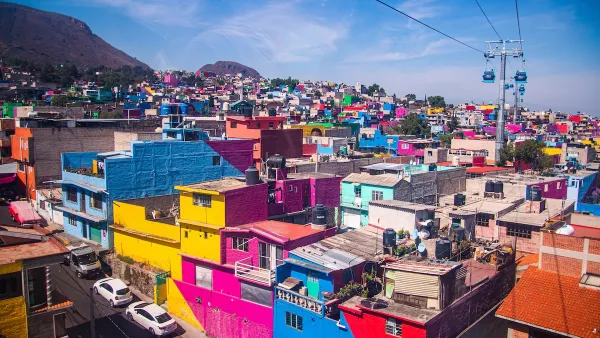
Mexico City Aerial ‘Cablebus’ Provides Key Connection to Peripheral Neighborhoods
Unlike many aerial gondolas, Mexico City’s Cablebus is largely used by commuters and residents from communities farther from the city center.

Planetizen Federal Action Tracker
A weekly monitor of how Trump’s orders and actions are impacting planners and planning in America.

The state-sanctioned urbicide of Austin
People don’t kill cities. Freeways do.

US to reduce Colorado River water deliveries to Mexico
A new Colorado Treaty amendment reduces Mexico’s Colorado River water allocation by 250,000 acre feet.

Baltimore to break ground on $50 million Transit Priority Project
The project will bring faster bus trips, safer streets and better bike connections to Baltimore.

Airbnb launches $250 million 'last-dollar financing' housing accelerator, makes first investment in Austin
The company will put $6.4 million towards affordable housing development in Texas’ capital.

Guerilla urbanists are building DIY bus stop benches in Chicago
A before-and-after of one of the bus stops with a new bench. The new benches are not officially sanctioned or permitted, but the residents who placed them hope they will be the start of a network of DIY benches across the city.

FREE Course: Walkable City 1: Why Walkability?
After describing his path towards focusing on walkability as the essence of good planning, Jeff Speck marches through his five principal reasons for making more walkable places.
Reinventing Malls: Planning Alchemy—Turning Gray Fields Into Gold
The course focuses on the opportunities and imperatives that shape reinvention of mall sites.

Eagle County Government
Harvard University Graduate School of Design
Nashville Planning Department
The Architects Foundation
University of Cincinnati Online
The Pocatello Development Authority
The Urban Renewal Agency of the City of Pocatello
Journal of the American Planning Association