The Hope Outdoor Galley, as Graffiti Park is officially known, will relocate to a decidedly less central location.


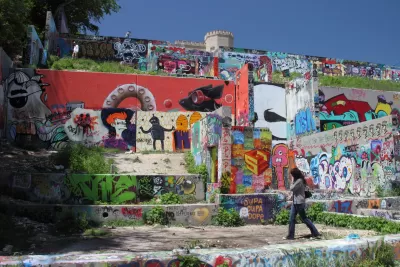
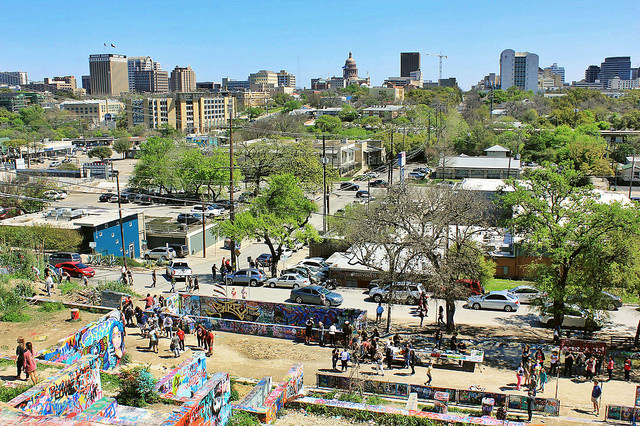
Austin's Historic Landmark Commission approved a demolition permit for the graffiti-covered concrete walls and slabs at HOPE Outdoor Gallery, known colloquially known as Graffiti Park.
"The graffiti-smothered area, officially known as the HOPE Outdoor Gallery, opened in 2011 to muralists following a South-by-Southwest event," according to an article by Christopher Neely. "The concrete walls and slabs that evolved into a public canvas were leftovers from a failed multi-family development from the 1980s."
"According to a press release sent out late last year, the HOPE Outdoor Gallery will move to 9507 Sherman Road, on Carson Creek Ranch in east Austin, close to the Austin-Bergstrom International Airport—a considerable distance from its current central Austin location," adds Neely. "The new location will provide more structure to the gallery and more space for artists and is expected to open by the end of 2018."
Out-of-town reporter Craig Hlavaty also picked up in the news, saying the demolition is proof that "Austin is about to get even less weird."
Read the full story: Demolition of Graffiti Park unanimously approved by Austin’s Historic Landmark Commission

Airbnb launches $250 million 'last-dollar financing' housing accelerator, makes first investment in Austin
The company will put $6.4 million towards affordable housing development in Texas’ capital.
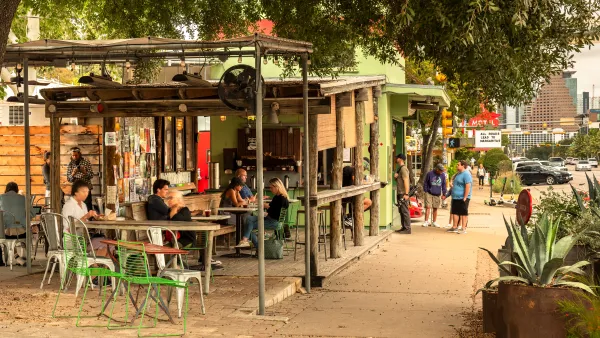
Large projects near Austin's light rail must include affordable housing
Elsewhere in the city, developers can pay into a city bank account for affordable housing rather than providing the required affordable units within their projects.
The new Texas law declawing NIMBYs
State lawmakers gutted an old Jim Crow-era state law that required a city council supermajority to approve a new housing development if neighbors petitioned the proposal.

Planetizen Federal Action Tracker
A weekly monitor of how Trump’s orders and actions are impacting planners and planning in America.

The state-sanctioned urbicide of Austin
People don’t kill cities. Freeways do.

Colorado’s Largest Data Center Could Rise Next to Homes — Without a Public Hearing
The proposed campus would consume 11 times the power of Denver International Airport; as it has across the country, opposition mounts.

Nation's most wind-powered state turns to coal as data centers increase energy demand
For the first time in decades, Iowa has increased its generation of coal power.

NYC cools commuters with city's first rain garden above a bus stop
New York City officials say the plants in the rain garden can absorb 16 gallons of rainwater during heavy storms.

Brightline West’s future may rely on $6 billion federal loan
The company has until Nov. 2 to make a $400 million equity investment into its proposed high-speed rail line.

FREE Course: Walkable City 1: Why Walkability?
After describing his path towards focusing on walkability as the essence of good planning, Jeff Speck marches through his five principal reasons for making more walkable places.
Reinventing Malls: Planning Alchemy—Turning Gray Fields Into Gold
The course focuses on the opportunities and imperatives that shape reinvention of mall sites.

Greater Baltimore Committee
Eagle County Government
Harvard University Graduate School of Design
The Architects Foundation
University of Cincinnati Online
The Pocatello Development Authority
The Urban Renewal Agency of the City of Pocatello
Journal of the American Planning Association