Residents will live in solar powered homes and ride around the community in self-driving, solar-powered shuttles. Babcock Ranch outside of Fort Myers, Florida, has been in the making since 2005. A city of 50,000 is forecasted.


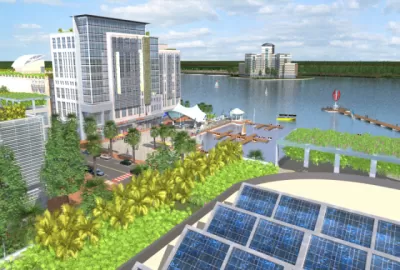
"Families are starting to move into what is being called America's first solar-powered town," announces John Dickerson for CBS This Morning on Jan. 16. "Babcock Ranch, about half an hour northeast of Fort Myers, Florida, is supposed to produce more energy than it consumes once it's finished."
Developer Syd Kitson is building 20,000 homes for a projected 50,000 people, states Dickerson in the newscast video accompanying the article.
There are more than 300,000 solar panels spread across 440 acres there, producing enough electricity not only for the town, but also the surrounding areas, reports CBS News' Manuel Bojorquez.
One critical energy element lacking in the solar-powered community will be adequate energy storage to allow the city to be truly self-powered:
The town doesn't run on solar power all the time. At night, when the sun is down, it has to draw from the traditional electrical grid. Kitson says the technology for storing all that surplus energy the solar cells generate during the day is still too costly.
The video starts with a tour of the site in a solar-powered, autonomous shuttle, hailed with an app, which will serve future residents, as well as Richard and Robin Kinley, the town's first residents. The lake was even named after them.
"I felt very much like when I bought a Tesla back in 2013 and I said, this is definitely is going to make it," Richard said. "I felt the same way about Babcock Ranch."
Like the Kinleys, Kitson, who has been working on the development since 2005, is keen on sustainability.
We want to be the most sustainable new town in the United States," Kitson said. "We had the advantage of a green field, a blank sheet of paper. When you have a blank sheet of paper like this, you really can do it right from the beginning."
Planetizen has followed the development since 2009. "More than half of the city's 17,000 acres will be permanently protected as greenways and open space, the developer said, and will adjoin the 73,000-acre Babcock Ranch Preserve that has been purchased by the state," notes the first post by Nate Berg.
The greenfield site that Kitson touts is the subject of the second post in 2011 by Shay Kahen that suggests that "when all construction CO2 emissions are factored in on these greenfield sites," a better model of sustainability is to make existing green cities, like New York, more sustainable through plans included in then Mayor Michael Bloomberg administration's PlaNYC, or today's OneNYC.
The third and final Planetizen post last year identifies significant sustainable attributes in addition to renewable energy.
The town will be walkable and bikeable, with 50 miles of nature trails. Residents will be able to plant crops in community gardens. Houses will be set near sidewalks so neighbors can more easily interact with one another. To encourage homeowners to drive electric vehicles, the town will install numerous charging stations. Its public vehicle fleet will be electric and driverless.
Read the full story: Babcock Ranch: Inside America's first solar-powered town

Water Situation Changes for Sprawling Phoenix-Area Development, Delayed by the Recession
The Phoenix metropolitan area is growing again, but the water supply isn't. Many development plans derailed by the Great Recession won't find it easy to start where they left off.
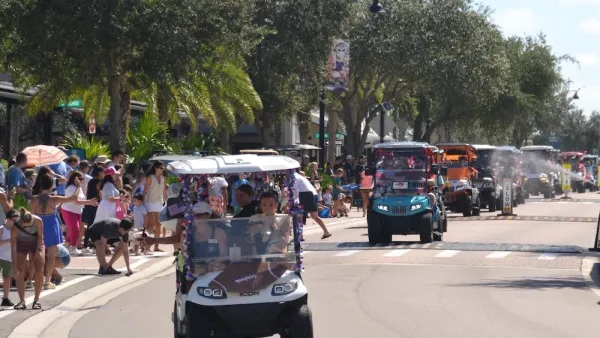
This Florida town gives residents a free golf cart with each new home
Babcock Ranch discourages driving with ample walking and rolling infrastructure and dense development that offers many of the services residents need within a short walk or ride.
City of Vacaville Launches Instant Solar Permitting
A new state law requires cities to take steps to speed up the permitting process for solar energy systems.

Planetizen Federal Action Tracker
A weekly monitor of how Trump’s orders and actions are impacting planners and planning in America.

California plans to bury El Niño’s downpour
If the state plays its cards right, it may be able to store a billion acre-feet of El Niño’s water in aquifers.

Desperate measures: Advocates weigh draining Lake Powell to fill Colorado River
Draining the reservoir could reduce evaporation losses by a couple hundred thousand acre-feet.

California city breaks ground on transit connector
The project includes three mobility hubs and a pedestrian bridge.

After public outcry, Massachusetts city releases housing development tracker
Cambridge’s tracker currently shows 250 housing projects in various stages of development.

40 years after approval, Chicago breaks ground on new park
The park honors Jean Baptiste Point du Sable, the city’s first permanent non-native settler.

FREE Course: Walkable City 1: Why Walkability?
After describing his path towards focusing on walkability as the essence of good planning, Jeff Speck marches through his five principal reasons for making more walkable places.
Reinventing Malls: Planning Alchemy—Turning Gray Fields Into Gold
The course focuses on the opportunities and imperatives that shape reinvention of mall sites.

City of Rosemead
Rutgers University, Edward J. Bloustein School of Planning and Public Policy
One Hundred Miles
Hunter College, City University of New York (CUNY)
The Architects Foundation
University of Cincinnati Online
City of Cambridge
Montrose County
The Pocatello Development Authority