Are greenfield developments designed with sustainability in mind or already-built metropolises better for the environment and the people?


Future communities such as the solar-powered Babcock Ranch in Florida or PlanIT Valley in Portugal will have to prove that they are actually livable cities that people want and demand for.
"If there is market demand for these communities, these developments may prove to be scalable and replicable. Only the early residents who buy in can determine if these places are truly livable. However, it remains to be seen whether these new developments will actually be sustainable when all construction CO2 emissions are factored in on these greenfield sites. How are these developers accounting for those emissions?
In contrast with these bold visions, pragmatic New York City, already one of the world's most sustainable cities, is focused on improving what it has. The city's model climate change mitigation and adaptation plan, PlaNYC, is being used to guide smart investments in the environment, and water and energy infrastructure."
Read the full story: Will the Eco-Cities of the Near Future Be Livable?
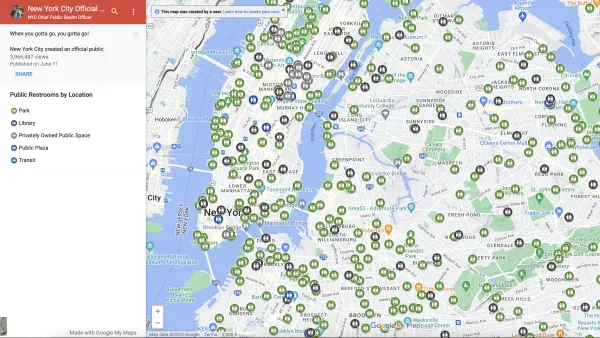
When You Gotta Go: NYC Launches Public Restroom Map
New York City created a Google Maps layer to help residents and tourists alike more easily locate public restrooms.

Meet NYC’s New Office of Livable Streets
The NYC DOT program will build on pandemic-era initiatives to promote safe and comfortable streets that enhance community and expand uses beyond just moving cars.
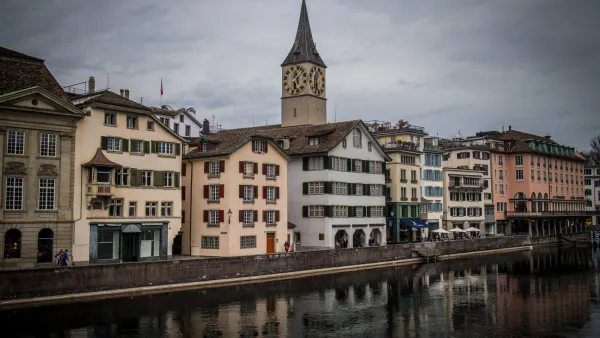
The Problem With All Those 'Livability' Rankings
Why is it that smallish cities in western Europe always score so well? Perhaps the underlying assumptions behind ostensibly data-driven "livability" rankings cater to a certain audience and leave most of us out.

Planetizen Federal Action Tracker
A weekly monitor of how Trump’s orders and actions are impacting planners and planning in America.

California plans to bury El Niño’s downpour
If the state plays its cards right, it may be able to store a billion acre-feet of El Niño’s water in aquifers.

Desperate measures: Advocates weigh draining Lake Powell to fill Colorado River
Draining the reservoir could reduce evaporation losses by a couple hundred thousand acre-feet.

Chicago voters approve permanent festival grounds, penalty for vacant property owners
Currently, major summer and fall festivals take over public parks for weeks at a time, drawing criticism from nearby residents

NYC votes to cut outdoor dining red tape, speed up permitting
New York City also voted to allow the Department of Transportation to begin work on urgent projects before notifying elected officials.

California appears to reject Prop. 45
The proposition would have expanded the projects that qualify for a streamlined environmental review, effectively paring down the California Environmental Quality Act.

FREE Course: Walkable City 1: Why Walkability?
After describing his path towards focusing on walkability as the essence of good planning, Jeff Speck marches through his five principal reasons for making more walkable places.
Reinventing Malls: Planning Alchemy—Turning Gray Fields Into Gold
The course focuses on the opportunities and imperatives that shape reinvention of mall sites.

City of Rosemead
Rutgers University, Edward J. Bloustein School of Planning and Public Policy
One Hundred Miles
Hunter College, City University of New York (CUNY)
The Architects Foundation
University of Cincinnati Online
City of Cambridge
Montrose County
The Pocatello Development Authority