Disease mapping made a significant leap forward in the 19th century, and data scientists and geographic information scientists are still contributing to the public health field.


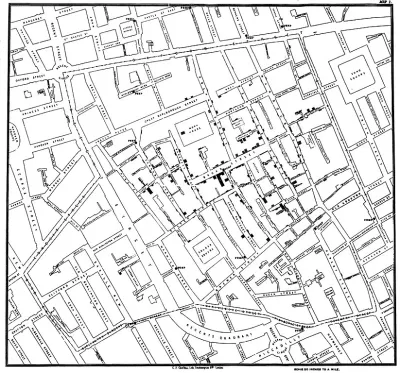
A post on the Sidewalk Labs blog explains an 1854 disease map that "changed the way cities studied public health."
"While many other innovations help keep city residents safe—sewers, fire safety, and vaccines all have more immediately observable effects—the disease map stands out for its ability to change the way we think about population health," according to the post.
Earlier attempts at mapping disease outbreaks failed due to bad assumptions and faulty science, but in 1854 John Snow mapped a London cholera outbreak and totally changed the public health profession's approach to epidemiology—and contributed to a new era of urban growth and industry. (It's no surprise, then, that Snow is often credited as the "father of epidemiology".)
Sidewalk Labs shares Snow's cholera map as the latest installment in the "15 Innovations That Shaped the City" series. According to the post, practices related to data collection and mapping continue to improve, and urban populations can expect even more improvements in public health.
FULL STORY: Disease Mapping: New Technology Meets an Ancient Discipline


Herd Immunity Finds Receptive Audience in White House and Florida
A trio of epidemiologists from Stanford, Harvard, and the University of Oxford have joined the president's new coronavirus medical advisor, Scott Atlas, in promoting an alternative approach to dealing with coronavirus infections.
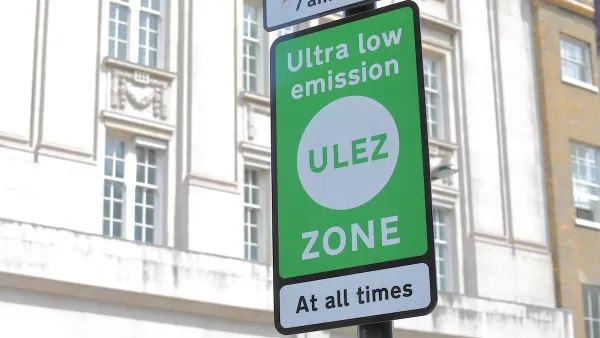
Study: London ULEZ Rapidly Cleaning up Air Pollution
Expanding the city’s ultra low-emission zone has resulted in dramatic drops in particle emissions in inner and outer London.

London Low-Emissions Zone Prompts Shift to Active Modes
More children are using active transportation modes to get to school in the wake of a policy that charges drivers to enter a low-emissions zone in central London.

Planetizen Federal Action Tracker
A weekly monitor of how Trump’s orders and actions are impacting planners and planning in America.

The state-sanctioned urbicide of Austin
People don’t kill cities. Freeways do.

US to reduce Colorado River water deliveries to Mexico
A new Colorado Treaty amendment reduces Mexico’s Colorado River water allocation by 250,000 acre feet.

5 New England states march closer to 800 megawatt wind energy project
Securing federal approval for the project may be complicated under the Trump administration, which has historically been hostile towards domestic wind power.

Baltimore to break ground on $50 million Transit Priority Project
The project will bring faster bus trips, safer streets and better bike connections to Baltimore.

Airbnb launches $250 million 'last-dollar financing' housing accelerator, makes first investment in Austin
The company will put $6.4 million towards affordable housing development in Texas’ capital.

FREE Course: Walkable City 1: Why Walkability?
After describing his path towards focusing on walkability as the essence of good planning, Jeff Speck marches through his five principal reasons for making more walkable places.
Reinventing Malls: Planning Alchemy—Turning Gray Fields Into Gold
The course focuses on the opportunities and imperatives that shape reinvention of mall sites.


Eagle County Government
Harvard University Graduate School of Design
Nashville Planning Department
The Architects Foundation
University of Cincinnati Online
The Pocatello Development Authority
The Urban Renewal Agency of the City of Pocatello
Journal of the American Planning Association