Renovations of historic structures in Philly are an example of the nationwide importance of the historic tax credit.


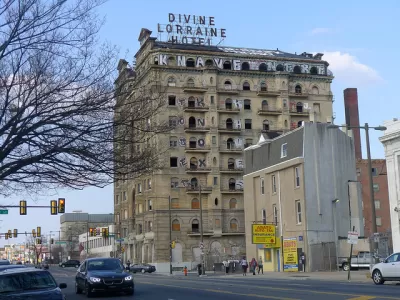
The historic tax credit is threatened in the current version of the House tax bill released last week. Its loss would greatly reduce developers' ability to renovate historic buildings and threaten cities' ability to revitalize older districts, and cities like Philadelphia already have a hard time saving old buildings even with the credit in place.
Architecture critic Inga Saffron of the Philadelphia Inquirer cites numerous historic renovations in Philadelphia that have relied heavily on the historic tax credit in order to pencil out. The Divine Lorraine is just one example. Writes Saffron, the Divine Lorraine:
"would never have been salvaged — never mind restored to its original architectural splendor — without the help of a federal incentive called the Historic Tax Credit. A tax write-off for people who invest in historic preservation, it was introduced in 1984 by President Ronald Reagan, who saw it as an economically sensible way to make America’s cities and towns beautiful again."
Saffron goes on to produce several other great examples of historic redevelopments across Philadelphia that have saved precious urban resources, spurred other revitalization, and are simply beautiful. As well, she notes National Trust research indicates more than 40,000 buildings have been restored nationwide, creating two million jobs. That alone is reason to save the historic tax credit.
Read the full story: GOP Tax Plan Would Kill Federal Program that Drove Philadelphia's Revival

Philadelphia Could Hit the Brakes on Housing
With bills on the table to update its zoning code, Philadelphia may be poised to slow the pace of its housing construction.
Philadelphia's Housing Incentives Shoot School Funding in the Foot
Philadelphia Inquirer Architecture Critic Inga Saffron is the latest to respond to an article in the Washington Post asking whether family-friendly cities make economic sense.
Why America Need Architecture Critics like Philadelphia's Inga Saffron
The writing of Inga Saffron "makes an ardent plea for more critics willing to take up the mantle of urban citizenship," according to a recent article in The Architectural Review.

Planetizen Federal Action Tracker
A weekly monitor of how Trump’s orders and actions are impacting planners and planning in America.

California plans to bury El Niño’s downpour
If the state plays its cards right, it may be able to store a billion acre-feet of El Niño’s water in aquifers.

Chicago breaks ground on $3 billion megadevelopment
The new neighborhood, titled Foundry Park, will one day host 3,700 residences.

Satanic place names
From streams and lakes to valleys and canyons, I mapped more than 1,000 places named after the Devil.

California High-Speed Rail Authority CEO resigns after $600,000 scandal
Under Ian Choudri, the authority used taxpayer dollars to fund first class flights and trips to nightclubs.

Want to study the Missouri River? Soon, you may need unanimous approval from 10 states
Legislation would require 10 governors’ permission to study or build projects moving water outside the basin.

FREE Course: Walkable City 1: Why Walkability?
After describing his path towards focusing on walkability as the essence of good planning, Jeff Speck marches through his five principal reasons for making more walkable places.
Reinventing Malls: Planning Alchemy—Turning Gray Fields Into Gold
The course focuses on the opportunities and imperatives that shape reinvention of mall sites.

City of Rosemead
Rutgers University, Edward J. Bloustein School of Planning and Public Policy
One Hundred Miles
Hunter College, City University of New York (CUNY)
The Architects Foundation
University of Cincinnati Online
City of Cambridge
Montrose County
The Pocatello Development Authority