Land Use
Parks Need Buildings, Too—A Silver Spring Transit Center Case Study
As the long-awaited Silver Spring Transit Center continues construction, voices in the community want to consider a park adjacent to the forthcoming Metro stop. Dan Reed writes, however, that the area might not be well suited for a park.
Pittsburgh Resets Clock for Steelers’ Open Space Proposal
Pittsburgh hopes for pedestrian-oriented public space at the corner of Art Rooney Avenue and North Shore Drive. The city’s planning commission recently granted its NFL franchise a third extension to develop a plan for the parking lot on the parcel.
The Best Complete Streets Programs of 2013
More than 80 communities adopted complete streets policies in 2013, bringing the national total to 610 jurisdictions with such policies. The National Complete Streets Coalition examined the newest programs for the best examples.
Exit Interview: D.C. Planning Director Harriet Tregoning Departs for HUD
During Tregoning's seven years at the helm of the Washington, D.C. Office of Planning, she pushed the city to adopt smart-growth policies touching all aspects of life--not just land use, but transportation, the economy, and more.
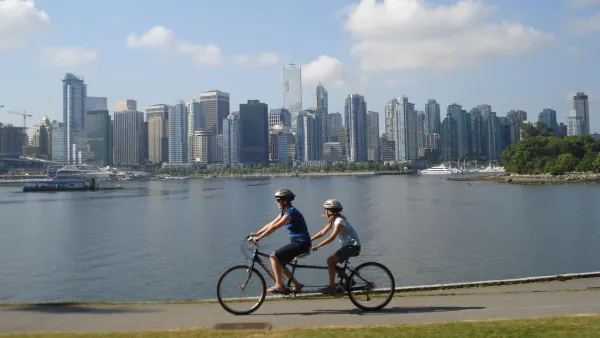
Learning from Vancouver’s Planning Successes
Vancouver’s reputation as a beautiful “mini-Manhattan” is well documented and well earned. But how did the city manage to fend off regrettable fashions in planning over the years, and how prepared is it to continue its success in the future?
Funding Appeal for Beaches in Massachusetts
The Metropolitan Beaches Commission has improved conditions and facilities at many of Massachusetts' beaches since its inception in 2006. Recently, however, the commission called for funding to be restored to pre-recession levels.
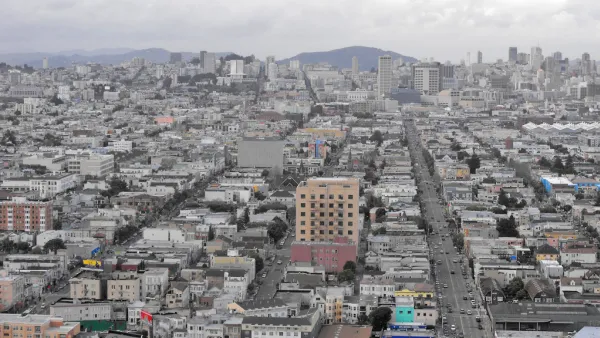
San Francisco's Running Out of Room for Cars
In terms of land area, San Francisco’s a small city. Yet if current policies persist, the city will build 92,000 parking spots for residents by 2040, on just 49 square miles of land.
Developer Bows in Downtown Toronto Big Box Battle
Torontonians who have been fighting a Walmart in Downtown’s belovedly indie Kensington Market neigbourhood appear to have won their battle against a goliath developer. A revised development proposal features significantly scaled-down retail units.

Libraries Remain Central to Communities
A recent study by the Pew Research Center shows that despite the increasing use of tablets and e-readers, Americans still love books and still rely on libraries as a central cultural institution.
Modern Love Looks Like Parking Tickets
Fools rush in, they say—with a little push from the Cambridge Traffic, Parking, & Transportation Department.
College Campuses as Multi-Modal Models for Cities
A new report argues that city governments have some of the same incentives for de-emphasizing single-occupant commuters as colleges—such as attracting younger workers and freeing up land used for parking.
Peak Sprawl Happened—20 Years Ago
Analysis of the USDA’s 2010 National Resources Inventory, which tracks land use, shows the growth rate of suburban sprawl peaking in the mid-1990s, declining by two-thirds since then, even through the most recent housing boom. How did that happen?
Imagining Silicon Valley Parking Lots as Corporate Housing
A series of renderings asks the question: "What might it look like if tech campuses replaced their parking lots and provided all the necessary housing on-site?"
De Blasio Selects Planning Director
Mayor Bill de Blasio has selected Carl Weisbrod, the co-chairman of his transition team and a veteran New York City real estate executive to be the Chair of the City Planning Commission, aka Planning Director. Housing affordablity will be a priority.

San Francisco Planners Pitch Freeway Removal
Planners in the city of San Francisco have a proposed a $1.4 million study to examine the possibility of removing part of Interstate 280 in the city and convert a rail yard would yield 37 acres of prime urban real estate.
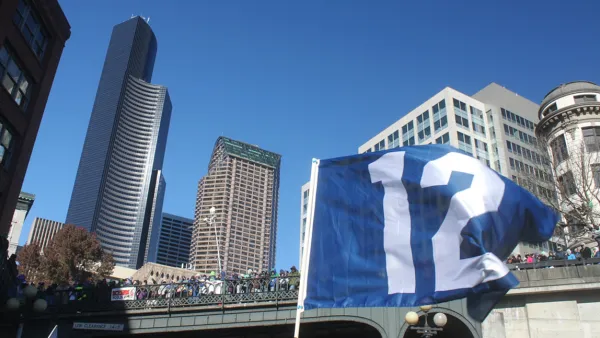
Placemaking Lessons Learned from Seattle's Super Bowl Parade
Last Wednesday, an estimated 700,000—more than the city's population of 635,000—welcomed the Seahawks home, without major incident. Writing in The Atlantic Cities, Chuck Wolfe describes five lessons for placemaking through words and photographs.
What Makes A ‘Metropolitan Version of Nature’?
Metropolis Magazine examines the 21st century efforts at creating wild places in cities, exemplified by the Buffalo Bayou Promenade in Houston and the Passaic River in Newark.

Arizona’s Suburb of the Future
Atlantic Cities details the new urbanist vision of a master planned community called Eastmark in Mesa, Arizona. The development’s mix of uses, form-based code, and walkability create “an uncommon sales pitch for car-dependent Arizona.”
Ballot Box Zoning Initiative Possible for San Francisco
Proponents of a ballot initiative that would require a vote for any development on the San Francisco waterfront that exceeds existing height limits have gathered enough signatures to put the issue to a vote.
Public Benefits Not Worth Density to Palo Alto Residents
Palo Alto’s planned community zoning has existed since 1951. As the real estate market in the Silicon Valley heats up, residents are questioning whether developers are abusing the density and height benefits they receive from the zoning code.

FREE Course: Walkable City 1: Why Walkability?
After describing his path towards focusing on walkability as the essence of good planning, Jeff Speck marches through his five principal reasons for making more walkable places.
Reinventing Malls: Planning Alchemy—Turning Gray Fields Into Gold
The course focuses on the opportunities and imperatives that shape reinvention of mall sites.

City of Rosemead
Rutgers University, Edward J. Bloustein School of Planning and Public Policy
One Hundred Miles
University of Michigan School for Environment and Sustainability (SEAS)
Hunter College, City University of New York (CUNY)
The Architects Foundation
City of Cambridge
Montrose County
The Pocatello Development Authority









