A map and website developed by PhD student Ethan Welty and friend Caleb Philip catalogs the cornucopia of edible trees found in the "urban orchards" of two-dozen cities around the world.



Last summer, Welty began to map the locations of peaches, apricots, walnuts, mulberries and plums he found along the streets of Boulder, Colorado. "In March, he and Caleb Philips, a professor of computer science at the University of Colorado, expanded that database into Falling Fruit, a website that catalogs more than half a million urban trees with edible products," reports Henry Grabar. "In the two-dozen cities where Welty and Philips have obtained municipal planting data or teamed up with local foragers, there is something to eat on nearly every corner."
"Welty hopes urbanites will begin to see the nutritional value in their surroundings," says Grabar. "All the momentum behind urban foraging will drive the planting of fruit trees," he imagines. "Maybe we could begin to build more edible cities deliberately."
FULL STORY: Hungry? Here's a Map of Every Urban Plant You Can Snack On

Mapping the Locavore's Food Supply
FiveThirtyEight and ESPN recently produced a short documentary about the creators of Falling Fruit—a website that maps food sources in cities around the world.
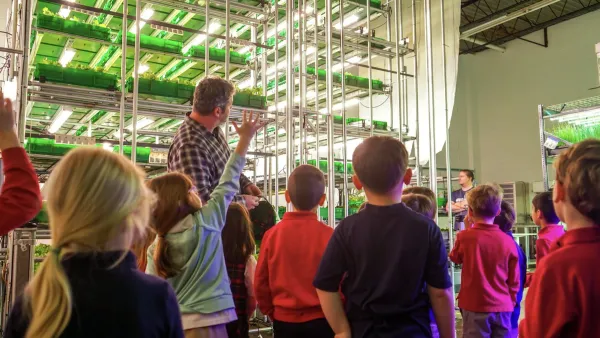
A Multimillion Dollar Virginia Company is Turning Empty Office Buildings Into Farms
Area 2 Farms envisions a world where 90% of the U.S. population lives within 10 miles of an indoor farm.

Boulder Eliminates Parking Minimums Citywide
Officials estimate the cost of building a single underground parking space at up to $100,000.

The state-sanctioned urbicide of Austin
People don’t kill cities. Freeways do.

US to reduce Colorado River water deliveries to Mexico
A new Colorado Treaty amendment reduces Mexico’s Colorado River water allocation by 250,000 acre feet.

New Jersey’s second-largest city bans standalone data centers
Jersey City will continue to allow co-location facilities, such as those meant for research institutions that store their own data.

Amtrak not solely to blame for New Jersey commuter rail's unreliability, report finds
A new study from the Garden State Initiative found that NJ Transit’s budget grew 20% across a 4 year period, but reliability declined significantly over the same period.

EPA erases limits on planet-warming pollution from power plants
Under Monday’s plan, power plants would still have some limits on how much mercury, arsenic and other contaminants they can emit.

Phoenix announces new on-demand transit service, more frequent RAPID buses
Both new services will launch in October, and are part of Phoenix's Project Effective Access Solutions for Easing Congestion.

FREE Course: Walkable City 1: Why Walkability?
After describing his path towards focusing on walkability as the essence of good planning, Jeff Speck marches through his five principal reasons for making more walkable places.
Reinventing Malls: Planning Alchemy—Turning Gray Fields Into Gold
The course focuses on the opportunities and imperatives that shape reinvention of mall sites.

Eagle County Government
Harvard University Graduate School of Design
Nashville Planning Department
The Architects Foundation
University of Cincinnati Online
The Pocatello Development Authority
The Urban Renewal Agency of the City of Pocatello
Journal of the American Planning Association