Kaid Benfield discusses two influential new publications that posit very different takes on the state of America's cities. While he finds elements to agree with in both, Benfield ultimately finds himself an optimist when it comes to our urban future.


Benfield discusses the divergent outlooks presented in The Metropolitan Revolution: How Cities and Metros Are Fixing Our Broken Politics and Fragile Economy, by the Brookings Institution’s Bruce Katz and Jennifer Bradley, and the State of the City: 5 Trends Impacting America’s Cities, released on Monday by Living Cities, "a consortium of philanthropic institutions working 'to improve the lives of low-income people and the cities where they live.'”
He muses on the arguments presented in both, but summarizes the difference thus: "where Katz and Bradley see excitement, innovation, leadership, and economic recovery, Living Cities sees declining city services, crumbling infrastructure, a failing educational system, unemployment, and struggling households."
Based on the truths that undergird each, he asks whether we should be optimistic about the future of cities, or pessimistic.
"I’m notorious for being the latter – I’m always convinced my favorite sports teams will lose – but, when it comes to cities, I’m more with Brookings," says Benfield. "I believe the state of cities (or, if you prefer, the future of metros) has never looked brighter in my lifetime. Yes, the inequality created by wealth distribution in our country is appalling; so is our educational performance; and many people are still hurting from the recession."
"But, if you think cities are hurting now, you should have seen them 20 or 40 years ago, when whole districts were being burned to the ground and people of means were fleeing as fast as they could, taking their tax dollars and businesses with them."
Read the full story: Two very different views of the condition of American cities

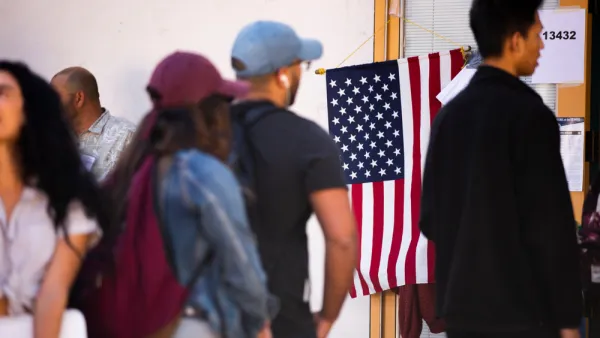
Brookings: A Demographic Post-Mortem of the Midterms
Young adults, according to a deep dive analysis by Brookings Metro demographer William Frey, were a key demographic group responsible for stopping the red wave that most polling predicted as the likely outcome of last month's midterm elections.
'The Great Real Estate Reset'
Business as usual in the real estate industry is failing the economy and the political and social cohesion of the United States, according to a new initiative launched by the Brookings Institution.
The Blue Beltway
Ronald Brownstein, a senior editor at The Atlantic, coins a new political-geographic term in the wake of the Georgia U.S. Senate runoff elections to describe a shift in the political alignment of nearly all large metropolitan areas in the nation.

Planetizen Federal Action Tracker
A weekly monitor of how Trump’s orders and actions are impacting planners and planning in America.

Amtrak, CN end decades-long dispute with eight-year agreement
The new operating agreement establishes an updated framework for the companies to work together, including processes to resolve disputes.

Judges permit Denver to divert 77,000 acre feet from the Colorado River for reservoir expansion
Overuse and climate change have caused the Colorado River’s water levels to plummet.

NYC DOT wants faster, more permanent street upgrades
The city is examining ways to build more concrete infrastructure without getting entangled in 'decades-long' projects.

'Something we’ve never seen before:' rising utility rates could strain city finances nationwide
Data centers, climate change and other factors have caused utility rates in the United States to increase by 38% since 2020.

Trump to overrule local leaders, lease millions of acres of America’s Pacific Island territories’ seafloors to mining companies
International law says that the Indigenous people of America’s territories have a right to prior and informed consent regarding projects that impact their countries.

FREE Course: Walkable City 1: Why Walkability?
After describing his path towards focusing on walkability as the essence of good planning, Jeff Speck marches through his five principal reasons for making more walkable places.
Reinventing Malls: Planning Alchemy—Turning Gray Fields Into Gold
The course focuses on the opportunities and imperatives that shape reinvention of mall sites.

Harvard University Graduate School of Design
KFH Group Inc.
Greater Baltimore Committee
The Architects Foundation
University of Cincinnati Online
The Pocatello Development Authority
The Urban Renewal Agency of the City of Pocatello