Infrastructure
Largest TIFIA Loan to P3 Goes to Florida's 'I-4 Ultimate' Project
Transportation Secretary Foxx announced the largest TIFIA loan to be awarded to a public-private partnership will be used to widen 21 miles of Interstate 4 in Florida known as "I-4 Ultimate" by adding four express or toll lanes in the Orlando area.
Op-Ed: Limit Parking to Limit Driving
Matthew Garbet contributes a guest column to the SaportaReport wherein he debunks the "Tipping Point Theory of Transit"—that cities should continue to support cars until a complete transit system is realized.
Detroit Bankruptcy Breakthrough: Regional Water Authority Moves Forward
One of the most politically treacherous proposals of Detroit's bankruptcy plan has finally gained approval—a regional water authority.
Nashville's New Bike-Friendly Bonafides: Bike Boxes
Bike boxes, a European import, may not have received as much attention other novel bike facilities such as protected bike lanes, but they are spreading. Nashville's first bike box accompanies a road diet and buffered bike lanes.
Survey Finds Chicago Drivers Failing to Yield for Pedestrians
A study finds that most drivers disregard for the rights of pedestrians to cross the road. Visual cues, however, provided by street design, greatly increase the likelihood that drivers will yield.

A New Guide to Green Infrastructure
With a growing body of research to support the construction of infrastructure that supports, protects, and even mimics natural systems, the American Society of Landscape Architects has released a guide to green infrastructure.
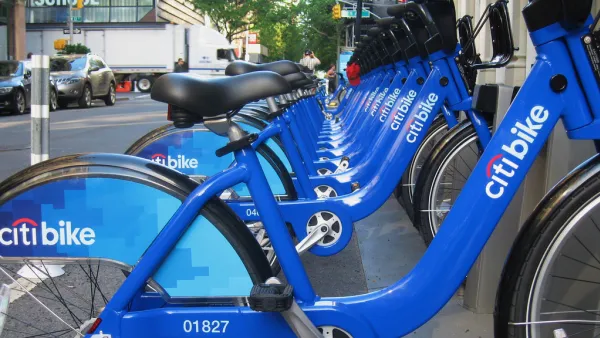
The United States' Top Large City for Biking Is...
Portland (top city in 2012)? Minneapolis (top city in 2010)? No, it's the Big Apple! New York City leaped from #7 in 2012 to the top spot this year for cities with populations of 100,000 or greater.
Prioritizing Resilience: Fraught with Challenges, But Worthwhile
In the face of climate change, making cities "resilient" before crises strike has become a pressing concern.
Integrating Health, Housing, and Resilience
The Urban Land Institute proposes the blending of solutions in housing and public health as a method of increasing the resilience of cities threatened by natural disasters of all kinds.
Is $1.4 Billion Enough Punishment for Deadly Natural Gas Explosion?
With a final decision expected later this year, the California Public Utilities Commission recommended a $1.4 billion fine for PG&E in connection with violations leading to a natural gas explosion in 2010.
Local Governments Onboard with Minneapolis' Southwest Light Rail
With a vote last week by the Minneapolis City Council, the final local consent was granted the proposed Southwest light rail project. Despite that benchmark political action, the project will not be without challenges moving forward.
Learning to 'Place-Decode' the Elements of Urbanism
Chuck Wolfe champions the role of France's attachment to place as a laboratory for decoding the essential elements of urbanism.
Plans for a 550-Mile 'Atlantic Coast Pipeline' Announced
A trio of natural gas providers is planning to build a 550-mile pipeline from West Virginia to North Carolina. The companies are hoping to secure approval for the project from the Federal Energy Regulatory Commission by 2016.
Euro-Envy Reconsidered: Talkin' Time, Distance, and Change
Most North American urbanists turn to Europe for inspiration and direction. Some of that brilliance, Ben Brown reminds us, is due to time and distance.
On the Political Effects of Transportation Infrastructure
A comparison of road conditions in Rwanda and Mali—the former an autocracy with sterling roads, the latter a democracy where poor road conditions reveal a deep divide in the country.
A Protected Bike Lane for Penn Ave in Pittsburgh
Michael Anderson reports on a proposed road diet and bike lane proposed for Penn Avenue in Pittsburgh, along a historic and cultural corridor in one of the country's oldest downtowns.
Plan Maps the Best (and Worst) of Future Road Construction
A new study published in the journal Nature maps out a plan for the development of roads around the world—where roads should be avoided due to their environmental costs, and where they can be built to maximize their potential benefit to humanity.
The Danger of Federal Money for Local Projects
Scott Beyer provides four reasons why federal money is the wrong policy mechanism for delivering the best possible transportation outcomes in the United States.
Cleveland Still Pondering Makeover for the Public Square
A plan to shut down streets around Cleveland's Public Square and make it a pedestrian friendly civic space has prompted many commenters to call for revisions to the plan, especially with regard to the square's heavy bus transit capacity.
When it Comes to Seismic Safety, It's Each City for Itself
Buildings constructed of unreinforced masonry get much if not most of the media's attention on seismic safety, but so-called 'soft story' wood buildings, often with garages on the ground floor, compose the greatest numbers of vulnerable buildings.

FREE Course: Walkable City 1: Why Walkability?
After describing his path towards focusing on walkability as the essence of good planning, Jeff Speck marches through his five principal reasons for making more walkable places.
Reinventing Malls: Planning Alchemy—Turning Gray Fields Into Gold
The course focuses on the opportunities and imperatives that shape reinvention of mall sites.

City of Thousand Oaks
City of Wisconsin Rapids
Harvard University Graduate School of Design
The Architects Foundation
University of Cincinnati Online
Northern Illinois Transit Authority (NITA)
The Pocatello Development Authority
The Urban Renewal Agency of the City of Pocatello