Environment
$1 Billion Disaster Recovery Competition Announced
Following the Rebuild by Design competition, which awarded $920 million in June, the Department of Housing and Urban Development announced another $1 billion competition for innovative resilience projects in communities recently struck by disasters.
Virginia Takes First Tentative Steps toward Climate Change Adaptation
A combination of environmental factors exposes Virginia’s coastal dwellers to some of the nation’s most severe climate change-related hazards, yet the state has almost zero plans for adaptation. Could that be about to change?
Proposed Pipeline Poses Dilemma for Keystone Pipeline-Supporting Governor
Iowa Governor Terry Branstad supports the Keystone XL Pipeline, as do most Republican leaders. Then again, it doesn't go through his state. Not so for the newly proposed Bakken Pipeline that cuts across the heart of Iowa. No word on his position yet.
California's New Emergency Drought Rules Require More Restrictions, Fines
Although some cities in California already have mandatory water restrictions in place, the State Water Resources Control Board adopted drought regulations this week that direct water agencies to ban wasteful practices.

University of Miami Sells Endangered Forest Land to Developer with Strip Mall Plans
Despite its commitment to protect forests in South Florida, the University of Miami sold 88 acres of endangered pine rockland to a developer with plans for a Walmart, an LA Fitness Center, and a Chik-fil-A, among other non-endangered retail uses.
Richmond, California Moves Ahead with $1 Billion Refinery Expansion Project
After a two day hearing late last week, the Richmond Planning Commission approved a contentious $1 billion plan to expand a Chevron refinery located in the city. The plan still requires city council approval.
Mayors Drop Cap and Trade from New Climate Agreement
The U.S. Conference of Mayors signed a voluntary agreement to reduce carbon emissions in their respective cities, as they did ten years ago, but dropped the provision that they lobby Congress to pass a cap and trade bill to reduce emissions.
Congress Progressing with Stopgap Transportation Funding Bill
Patch bills advanced in the Senate and the House on Thursday that would keep the Highway Trust Fund solvent through May 2015—good news for state DOTs that will see reduced federal reimbursements on August 1 unless a funding bill is passed soon.
Blue Urbanism: Connecting Cities and Oceans
A new book called 'Blue Urbanism: Exploring Connections between Cities and Oceans,' by Timothy Beatley, argues that cities must expand their understanding of urbanism to include their impacts on the oceans.
Sans Litter Ban, Tubers Trash Rivers in Texas
Tubers and tourists had their right to litter protected by a district judge in Texas. What they got as a result was…a lot more litter.
Bipartisan Opposition to Cap and Trade for Transportation
Opposition is stirring in industry and within the California legislature over the inclusion of oil refineries* in the cap and trade program come Jan. 1. Warning of a new tax on gas, opponents hope to delay the requirement for transportation fuels.

Density is Key to Fighting Climate Change, Rules Bay Area Judge
A group that coined the term, "stack and pack" to deride density and its role in reducing carbon emissions lost in court when the judge rejected their argument that only technological improvements in cars and fuels were necessary to reduce emissions.
Grand Canyon Development Plans Opposed by National Park Service
Two projects proposed for the South Rim plateau of the Grand Canyon have raised alarms at the National Park Service, who see a serious threat from impacts to the views, water supply, and ecology of the canyon.
Stormwater Systems as Development Incentives
The GreaterPlaces website gathered information from the "Shared Stormwater Systems as Economic Incentives" panel at the 2014 APA National Conference to outline how shared stormwater systems can enhance the environment and retain business.
California's 'Emergency' Drought Relief Funding Unspent
California has approved nearly $700 million in "emergency" drought relief funding, but much of it remains unspent, which begs the question: Are emergency measures an appropriate of effective response to the drought?
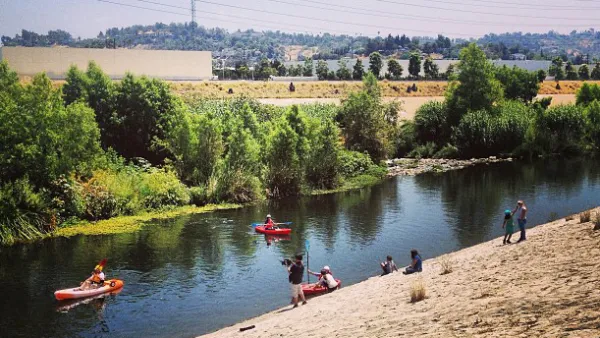
Los Angeles River Visionary Reflects on $1 Billion Recommendation for Revitalization
When the U.S. Army Corps of Engineers announced its preference for a $1.08 billion plan to restore habitat in the Los Angeles River, many credited Lewis MacAdams's fight to change the city's relationship with its waterway over nearly three decades.

Land Use Planning Crucial for Mitigating Pipeline Hazards
Open Access to Anna Osland's Article, "Using Planning to Mitigate Hazards from Hazardous Liquid and Natural Gas Transmission Pipelines." Link here: http://goo.gl/bDYGJg. Osland finds land use planning is overlooked in N.C. pipeline networks.
U.S. Supreme Court Approves California's Low Carbon Fuel Standard
A key regulation in California's war on global warming emissions withstood a major court challenge by the energy industry—both oil and corn ethanol—when the U.S. Supreme Court declined to hear their challenge to an Appeals Court ruling on June 30.
The Texas-Sized Impact of the 'Prior Appropriations' Water Management System
Christian McPhate and Ashlea Sigman provide a thorough and insightful read about the environmental impacts of Texas' water management policies, especially along the Brazos River, a drought-stricken water supply that cuts across the state.
Harley-Davidson Goes Electric
The green, quieter model runs on lithium batteries and gets 100 miles per charge. The Milwaukee company hopes it will appeal to a younger, urban, environmentally-conscious demographic as it's main market has been "aging white male baby boomers."

FREE Course: Walkable City 1: Why Walkability?
After describing his path towards focusing on walkability as the essence of good planning, Jeff Speck marches through his five principal reasons for making more walkable places.
Reinventing Malls: Planning Alchemy—Turning Gray Fields Into Gold
The course focuses on the opportunities and imperatives that shape reinvention of mall sites.

City of Rosemead
Rutgers University, Edward J. Bloustein School of Planning and Public Policy
One Hundred Miles
University of Michigan School for Environment and Sustainability (SEAS)
Hunter College, City University of New York (CUNY)
The Architects Foundation
City of Cambridge
The Pocatello Development Authority
The Urban Renewal Agency of the City of Pocatello









