As a 2012 law aimed reforming the "increasingly unsustainable" National Flood Insurance Program goes into effect, some homeowners in coastal areas are seeing dramatic increases in their insurance rates. Lawmakers are pondering how to ease the pain.


"Sharp increases in federal flood insurance rates are distressing coastal homeowners from Hawaii to New England and are starting to hurt property values and housing sales in areas just beginning to recover from the recession, according to residents and legislators," report Lizette Alvarez and Campbell Robertson.
On October 1st, the Biggert-Waters Flood Insurance Reform Act began to remove the subsidies that held down flood insurance rates for more than a million homeowners across the U.S.
“'The homeowners and business owners simply cannot withstand these gargantuan hikes,' said Senator Bill Nelson, a Florida Democrat and member of the bipartisan group of lawmakers pushing a bill to delay the increase. 'There is a lot of panic about this.'”
"Still, in recent years, costly flooding disasters, including Hurricane Sandy, have left the [National Flood Insurance Program] $25 billion in debt, a situation that will most likely worsen because of climate change and coastal overdevelopment," add Alvarez and Robertson. "And almost everyone involved agrees that the issue is not whether to change the program, but how to soften the impact on those hit hardest by the cost increases."
Read the full story: Cost of Flood Insurance Rises, Along With Worries

Congress Still Exploring Fix for Flood Insurance Expenses
With the National Flood Insurance Program deeply in debt, homeowners are struggling to afford new insurance rates resulting from legislation passed in 2012. The House could still block the Senate bill that would delay more rate increases.
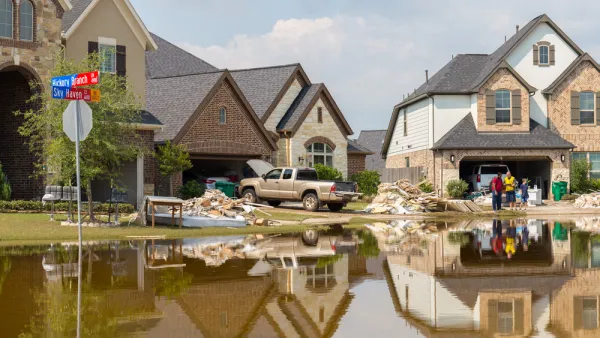
Hurricane Harvey and the Failure of the National Flood Insurance Program
Houston's most recent natural disaster is only the latest example of how a program created to help homeowners has been a greater benefit to the industries that profit from them.
New York Department of City Planning Releases Flood Retrofitting Manual
As federal law shifts to address resilience in post-Hurricane Sandy New York, the Department of City Planning has released a new manual to help residents and landowners understand options for retrofitting their buildings to prepare for floods.

Planetizen Federal Action Tracker
A weekly monitor of how Trump’s orders and actions are impacting planners and planning in America.

California plans to bury El Niño’s downpour
If the state plays its cards right, it may be able to store a billion acre-feet of El Niño’s water in aquifers.

Chicago breaks ground on $3 billion megadevelopment
The new neighborhood, titled Foundry Park, will one day host 3,700 residences.

California High-Speed Rail Authority CEO resigns after $600,000 scandal
Under Ian Choudri, the authority used taxpayer dollars to fund first class flights and trips to nightclubs.

Want to study the Missouri River? Soon, you may need unanimous approval from 10 states
Legislation would require 10 governors’ permission to study or build projects moving water outside the basin.

Desperate measures: Advocates weigh draining Lake Powell to fill Colorado River
Draining the reservoir could reduce evaporation losses by a couple hundred thousand acre-feet.

FREE Course: Walkable City 1: Why Walkability?
After describing his path towards focusing on walkability as the essence of good planning, Jeff Speck marches through his five principal reasons for making more walkable places.
Reinventing Malls: Planning Alchemy—Turning Gray Fields Into Gold
The course focuses on the opportunities and imperatives that shape reinvention of mall sites.

City of Rosemead
Rutgers University, Edward J. Bloustein School of Planning and Public Policy
One Hundred Miles
Hunter College, City University of New York (CUNY)
The Architects Foundation
University of Cincinnati Online
City of Cambridge
Montrose County
The Pocatello Development Authority