Community / Economic Development
Emulation is More than Flattery
We all have our role models in life. Never are they more pivotal than in the visioning required for placemaking. Failing to have patterns that perform economically, socially, and environmentally is a critical mistake says Nathan Morris.
Time Takes Toll on Loyal Opposition to Atlantic Yards
A decade of relentless, and exhausting, opposition by those "who saw democracy being trampled in the interest of a developer whose methodology they found offensive," has taken its toll on the ranks of opponents to Brooklyn's Atlantic Yards project.
Why Cities Should Think Twice Before Rolling the Dice on Gambling
Seen as a source of economic development and easy money for cities (struggling or not) throughout North America, casino projects are neither a revenue panacea nor the win-win "economic bullet" that supporters claim, argues Richard Florida.
D.C. Limits Parking to Promote Bicycling and Transit
As part of a broader effort to encourage less vehicular traffic city-wide, D.C. is expanding permit parking and reducing on-street parking in some of the city's most crowded neighborhoods. Not all are happy with the changes, reports Tim Craig.
Is the Arctic Poised to Become the Next Silk Road?
Philip Bump contemplates a future in which Arctic Ocean trade routes give rise to thriving port cities dotting the northern coasts of North America and Eurasia alike.
The Steps to Creating a Meaningful Vision
In the three steps of placemaking, crafting a meaningful vision is the first and most straightforward, yet it's the most under-leveraged. Continuing his series on "Municipal Placemaking Mistakes," Nathan Norris describes how to get it right.
Miami's Real Estate Heats Up, Could a Thunderstorm Be Far Off?
Despite all odds, “Miami’s roller coaster real estate market is booming again” reports Nadja Brandt. Is "the hottest [residential] real estate market in the U.S." primed to boil over?
The Secret Plans for Containing New York's Next Housing Emergency
Hurricane Sandy exposed the need for New York City to be able to house large numbers of residents following natural disasters. Matt Chaban examines the Bloomberg administration's "secret" plan to build modular apartments out of shipping containers.
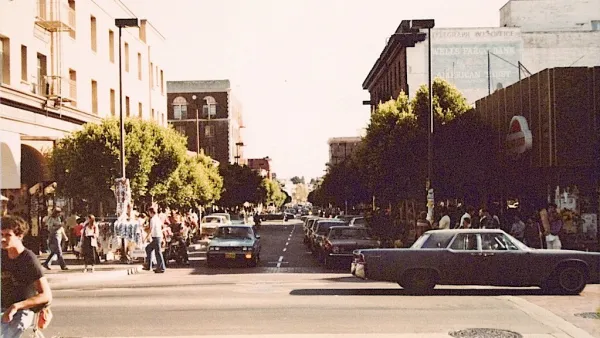
The Swan Song of Telegraph Avenue?
Soumya Karlamangla profiles a once-thriving hippie mecca, hit by hard times and largely abandoned, even by the nearby student population. Is it down for the count?
Airport Expansion: A Losing Bet
Often depicted as drivers of local economies, airports have struggled to stay profitable as passenger air travel continues to languish. Steve Malaga presents the case that throwing money at this particular problem can actually make things worse.
Selling the Importance of Street Vending
In the latest entry in a series on informal urban livelihoods, Sally Roever of WIEGO provides insight into how planners can better understand, acknowledge and manage street vending through the development of appropriate policies and best practices.
A Clash of Cultural Sensibilities in South Philly
Allyn Gaestel outlines the tensions that arise as a growing Vietnamese community begins to define the visual character of Washington Ave. in South Philadelphia.
A Roadside Distraction from the Destination
As the holiday travel season begins, Becky Krystal reminisces on rest stops encountered along family road trips and observes that "stops are evolving from small, flypaper-plastered restrooms into airy, high-tech travel plazas and welcome centers."
Could Nation's Largest Urban Farm District Stabilize Chicago's South Side?
Officials in Chicago envision an ambitious plan for a 100-acre urban agriculture district as the foundation for reviving an area of the city now "riddled with vacant lots, poverty, and blight," reports Lori Rotenberk.
Higher Home Values Preserved in Mixed-Income, Medium-Density Suburbs
A new study of the Philadelphia area commissioned by the Congress for New Urbanism “finds new urban characteristics play a role” in how households and neighborhoods weathered the recent economic downtown.

Sparking Creativity in Walkable Places
Happiness and health are generated or depleted by the way our neighbourhoods, towns, cities, and rural landscapes are developed. Creative placemaking adds to walkable urbanism by sealing the deal on physical, mental, and social well-being.
From Sparks of Brilliance to Waves of Reform
Bottom-up urbanism, now becoming increasingly popular in the academy under the rubrics of “do-it-yourself (DIY) urbanism”; “guerilla urbanism”; “tactical urbanism” etc., are the surest sparks of brilliance and hope for our urban future.
Copenhagen Tops List of Europe's Smartest Cities
Based on a new metric he's developed for defining the components of a smart city, Boyd Cohen ranks the top cities in Europe that are "working the hardest to be the most advanced urban landscape."
Airbnb Draws Tourists Off the Beaten Path
Airbnb connects travelers from around the world to unique rentable spaces. With the recent launch of a "Neighborhoods" feature, Airbnb has the potential to redirect tourist spending to often overlooked areas.
A Housing Plan to Keep Young Professionals in Massachusetts
Young professionals are choosing to live in "smaller, more transit-oriented developments." To keep them in-state, Gov. Deval Patrick plans to incentivize the building of 10,000 multifamily housing units each year through 2020 in Mass.

FREE Course: Walkable City 1: Why Walkability?
After describing his path towards focusing on walkability as the essence of good planning, Jeff Speck marches through his five principal reasons for making more walkable places.
Reinventing Malls: Planning Alchemy—Turning Gray Fields Into Gold
The course focuses on the opportunities and imperatives that shape reinvention of mall sites.

City of Rosemead
Rutgers University, Edward J. Bloustein School of Planning and Public Policy
One Hundred Miles
University of Michigan School for Environment and Sustainability (SEAS)
Hunter College, City University of New York (CUNY)
The Architects Foundation
City of Cambridge
Montrose County
The Pocatello Development Authority









