California's Central Valley was one of the areas hardest hit by the Great Recession, with several of its cities still burdened by the worst unemployment rates in the country. Signs in Bakersfield, however, point to a burgeoning boom.


According to Ricardo Lopez, the mid-size Central Valley city best known for oil, agriculture and country music, is becoming a boomtown, with employment and population growing at a brisk pace. Lopez attributes the city's good fortune to, "A price-fueled energy bonanza, low corporate operating costs and an
advantageous location." With government spending up, corporations expanding into the area, and the number of jobs just shy of peak levels, the area is on an upward trend.
"But despite these gains," notes Lopez, "county economic planners say Bakersfield is still hindered by a variety of weaknesses. Among them, they say, many outsiders view the city as little more than a
dusty industrial and agriculture town near an interstate."
A poorly educated workforce is another challenge. That's why Richard Chapman, president of the Kern County Economic Development Corp., believes that, "Developing residents' skills is a priority to ensure that
employment growth is more widespread and includes well-paying jobs for
area residents."
"The only thing that can stop us," Chapman said, "is the availability of the workforce."
Read the full story: Many signs point to a Bakersfield boom

California high-speed rail accomplishes only one legislative goal in 2026
The majority of the agency's failed pitches were never developed into written proposals.

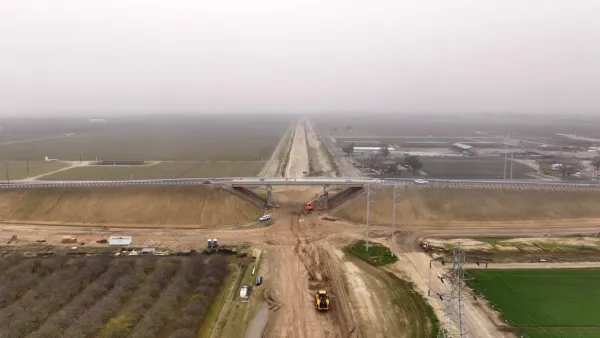
California High-Speed Rail Recommits to Bakersfield-to-Merced Segment
The California High-Speed Rail Authority also certified the Final Environmental Impact Report/Environmental Impact Statement for the San Francisco to San Jose section of the route in August.
California Budget Includes $4.2 Billion for High-Speed Rail
The recently approved state budget directs $4.2 billion in bond funding to the Bakersfield-to-Merced leg of California’s long-awaited high-speed rail project.

Planetizen Federal Action Tracker
A weekly monitor of how Trump’s orders and actions are impacting planners and planning in America.

California plans to bury El Niño’s downpour
If the state plays its cards right, it may be able to store a billion acre-feet of El Niño’s water in aquifers.

Chicago breaks ground on $3 billion megadevelopment
The new neighborhood, titled Foundry Park, will one day host 3,700 residences.

One of Denver’s busiest corridors to gain BRT
The project will span 18 miles and contain 74 bus rapid transit stations.

275,000 bus trips are at stake on Seattle's ballot
If passed, the Seattle Transit Measure would trigger a 0.3% sales tax and raise an average of $138 million per year to maintain and expand Seattle’s bus services.

Texas may pay Israeli company billions to ease water woes
Texas awarded IDE Technologies the contract for its Harbor Island project, which is slated to become the Western Hemisphere's largest desalination plant.

FREE Course: Walkable City 1: Why Walkability?
After describing his path towards focusing on walkability as the essence of good planning, Jeff Speck marches through his five principal reasons for making more walkable places.
Reinventing Malls: Planning Alchemy—Turning Gray Fields Into Gold
The course focuses on the opportunities and imperatives that shape reinvention of mall sites.

City of Rosemead
Rutgers University, Edward J. Bloustein School of Planning and Public Policy
One Hundred Miles
Hunter College, City University of New York (CUNY)
The Architects Foundation
University of Cincinnati Online
City of Cambridge
Montrose County
The Pocatello Development Authority