Defenders of suburban expansion argue that government should build more roads in order to open up more land for housing. What's wrong with that argument?



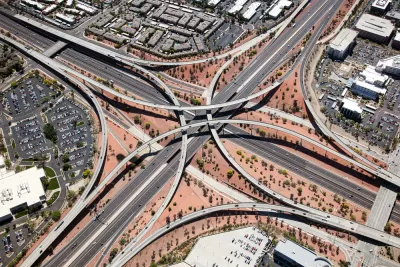
The traditional libertarian-ish argument for suburban sprawl is that it is a product of the free market, and what the free market has created, no government may tear asunder. A wide variety of popular and scholarly commentary (including plenty of my own work) has criticized this view, by pointing out that government has encouraged automobile-dependent suburbia in a wide variety of ways.
As demand for urban housing has grown, the 1990s view that consumers prefer suburbs to urban cores has become implausible. But as housing costs have exploded, a new pro-sprawl argument has risen in its stead: the theory that government-supported suburbanization makes housing more affordable by opening up new land for development. For example, in his generally worthwhile recent book Order Without Design, Alain Bertaud writes that to "maintain a responsive supply of developed land, municipalities must therefore finance and build the expansion of primary infrastructure into a city’s periphery." In the U.S. context, such "primary infrastructure" usually means sprawl-generating highways.
This argument has a significant basis in fact: sprawling American cities do generally tend to be cheaper than compact ones (though there are exceptions in both directions: walkable Philadelphia is cheaper than sprawling San Diego). But it also seems to me that sprawl is not the best way to create more housing, for several reasons.
First, although sprawl is one way to create extra land, it is not the only way to do so. As Bertaud wisely notes, a city can "create" additional land by allowing more housing on urban land. For example, if a city allowed more multistory buildings instead of reserving huge chunks of cities for single-family houses, it would essentially be creating developable land in the air, thus increasing the supply of land. Similarly, if the city allowed smaller yards, it would increase the supply of land available for housing. This need not mean a city of 90-story skyscrapers; cities could allow incremental height increases instead, so that neighborhoods now reserved for one-or two-story houses could have four-story apartment buildings, and places with four-story apartment buildings could have eight-story buildings.
Second, sprawl creates transportation costs for drivers that at least partially offset the benefits of cheap real estate. For example, a typical household in Suffolk County, Long Island (the outer suburb where I work) spends over $14,000 on transportation, while a typical household in Manhattan spends just below $6,300 and a typical household in Queens spends just over $8,200 (more data here). It could be argued that the transportation cost gap between driving and active transportation is artificially inflated by public subsidies for public transit. But if policymakers use public transit subsidies as an excuse to support pro-sprawl policies, they are creating a self-fulfilling prophecy: pro-sprawl policies force transit to cover more territory to serve the same number of people, thus making transit more expensive and increasing per-capita transit subsidies. For example, New York's subway loses less than $1 per ride, while the rail systems of sprawling cities such as Santa Clara lose far more.
Third, sprawl development creates a variety of externalities that are typically not reflected in housing costs. The growth of automobile-dependent suburbs leads to increased vehicle use, which leads to increased greenhouse gas emissions and other pollution of all sorts, as well as increased likelihood of death and injury from automobile crashes.
In theory, it is possible that these externalities could be taxed and regulated away. For example, a state could calculate the social cost of automobile-related pollution, and impose a tax or fee sufficient to equal that cost. But sprawl actually makes it less likely that this could occur; when most people spend their lives inside their automobiles, they are likely to resist any attempts to tax auto use, and increased taxation of cars becomes politically radioactive.
It could also be argued that the rise of electric cars or some other technology will wipe out the environmental impacts of cars. This argument lacks merit, because in recent years American automakers and consumers have chosen gas-guzzling, dangerous sport utility vehicles rather than energy-efficient vehicles. As a result, American vehicles are not as energy-efficient as some of their European counterparts. Moreover, a single-minded focus on miles per gallon overlooks the other externalities caused by sprawl, such as increased injuries and death from speeding vehicles.
In sum, a government that aggressively promotes sprawl development might increase the supply of housing. But there are more environmentally friendly ways of achieving the same result.

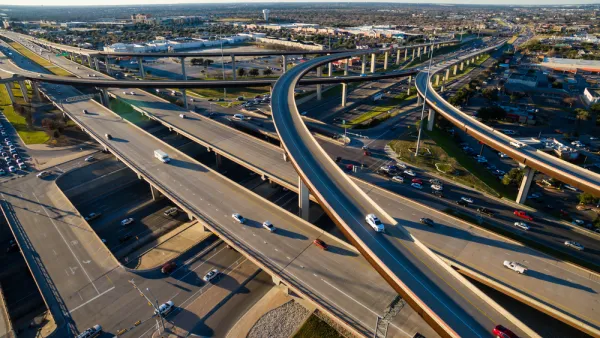
The True Cost of Texas Highways
An explainer of the monetary, environmental, and social costs of exuberant road building.
‘Divided by Design’ Underscores Inequities in Transportation Policy
The report calls for a wholesale overhaul of U.S. transportation policy to redress the damages caused by decades of auto-centric development.
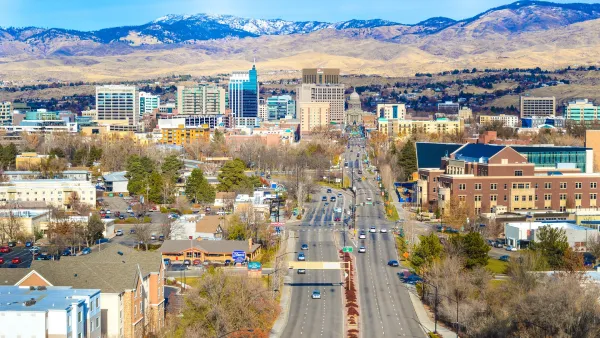
Boise’s New Planning Director Warns Against 'Dysfunctional Highways'
On the heels of his stint as Atlanta’s planning director, Tim Keane says Boise should avoid following in the path of American cities that have let highway expansion and sprawl go unchecked for decades.

Planetizen Federal Action Tracker
A weekly monitor of how Trump’s orders and actions are impacting planners and planning in America.

Amtrak, CN end decades-long dispute with eight-year agreement
The new operating agreement establishes an updated framework for the companies to work together, including processes to resolve disputes.

Judges permit Denver to divert 77,000 acre feet from the Colorado River for reservoir expansion
Overuse and climate change have caused the Colorado River’s water levels to plummet.

Philadelphia to invest $2 billion into upgrading city airports as PHL places last in customer satisfaction
Modernizations to Philadelphia's airports will include baggage system upgrades and a new automated parking garage guidance system.

The LA housing policies making developers turn away from the city
Despite LA’s housing shortage, developers say the city’s "mansion-tax" and pandemic-era policies make it an unappealing place to build housing.

New density bill would require 7 California cities to establish regional transit hubs
The bill would also require major cities in California to permit high-rise residential buildings.

FREE Course: Walkable City 1: Why Walkability?
After describing his path towards focusing on walkability as the essence of good planning, Jeff Speck marches through his five principal reasons for making more walkable places.
Reinventing Malls: Planning Alchemy—Turning Gray Fields Into Gold
The course focuses on the opportunities and imperatives that shape reinvention of mall sites.

City of Wisconsin Rapids
Harvard University Graduate School of Design
KFH Group Inc.
The Architects Foundation
University of Cincinnati Online
The Pocatello Development Authority
The Urban Renewal Agency of the City of Pocatello

