Social / Demographics
New York City: More Affordable Than You'd Think, for Some
For professional-class workers with annual household incomes in the top income quintile, New York is a comparatively affordable place. A recent study attributes lower costs to competition between businesses that cater to upper-income people.
World Bank: Carbon Pricing Key to Tackling Climate Change and Poverty
World Bank President Jim Yong Kim explains why climate change is a poverty issue - and why we must tackle it today to ensure that carbon emissions do not continue rising after 2016. Establishing a world price on carbon will be difficult to achieve.
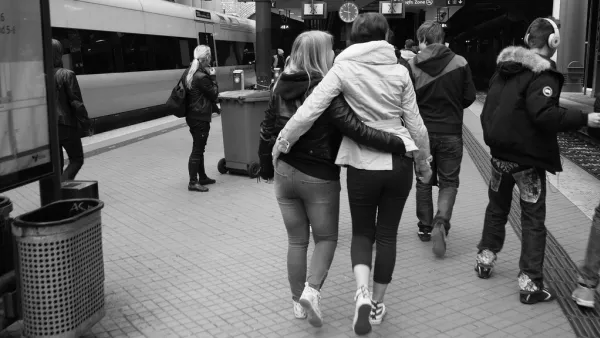
Young Americans Drive Historic Decline in Auto Usage
Brad Plumer looks at the latest data on Americans' driving habits, which shows that vehicle miles driven have fallen an astonishing 8.75 percent since June 2005. Despite the end of the recession, driving rates continue their downward trend. But why?
Number of New Yorkers In, or Near, Poverty Continues to Rise
Despite the end of the recession, the number of New Yorkers in, or near, poverty continues to creep up, with 46 percent of the city's residents making less than 150 percent of the poverty threshold, reports Sam Roberts.
Walking: America's Next Medical Breakthrough
A group of America's leading corporations, health care providers, and government officials are preparing to launch a national walking movement this fall. "If walking was a pill or surgical procedure, it would be on 60 Minutes,” says Dr. Bob Sallis.
Understanding Trends from the APA Conference
Every year we analyze all of the tweets from the APA Conference and tell you about the trends in planning. With more than 1,000 people tweeting from the APA Conference, there is a lot of great ideas, links, and blogs that we can all learn from.
Suburbs and Exurbs Were Hit Hardest by Great Recession
A new report from the Brookings Metropolitan Policy Program shows that areas located 10-35 miles from America's central cities sustained far higher job losses during the recession, staunching the sprawl of people and employment.
Will L.A. Overturn a Controversial Fast Food Ban?
After four years of banning the construction of new stand-alone fast food restaurants in South L.A., the city's planning department is considering raising the ban amid increasing questions about the impact of food deserts on obesity.
Activist Cyclist Peddles Women's Rights in Afghanistan
Jed Lipinski profiles Shannon Galpin, avid cyclist and founder of a nonprofit organization to aid women in conflict zones, who is hoping to improve women's rights in Afghanistan by supporting its fledgling bicycle culture.
Gentrification Provides an Opportunity to Diversify Urban Schools
Segregated schools are an enduring problem in urban America. But with young affluent (often white) professionals flocking to cities, and enrolling their children in public schools, a historic opportunity exists to create diverse schools.
Which cities are (perceived as) safest?
A Gallup poll asked residents of each Congressional district whether they felt safe walking alone at night in their city or area. Although city residents feared crime more than suburbs, there were some surprises.
Atlanta Artist Paints Suburban Ennui
Today's suburbs have discarded the human-scaled patterns they once promised. This newly resurfaced series of paintings from Atlanta artist Meg Aubrey will leave you longing for the world we neglected to build.
Olympics Earn a Gold Medal in Displacement
Lawrence Vale and Annemarie Gray compare the cases of communities displaced by the Olympics in Rio de Janeiro, where redevelopment for the 2016 Games is underway, and Atlanta, 20 years ago.
Migration of American Indians Transforms Cities and Reservations
The last several decades have seen a mass migration of American Indians from reservations to North America's urban areas, but federal funds that are supposed to assist them have not followed. Answers are elusive for how to stem endemic poverty.
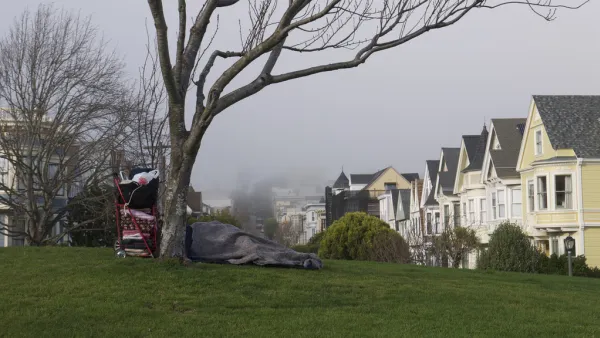
How Middle-Class Anti-Gentrifiers Obscure San Francisco's True Problems
In San Francisco, the relatively affluent are vocal in their denunciation of the "gentrifying" effects of the more affluent. This debate clouds the city's fundamental problems in housing its poor and working class residents, says Ilan Greenberg.
Environment Explains Obesity
Tara Haelle examines the growing consensus among scientists that environmental factors, rather than genes or sloth, are the primary cause of childhood obesity. The onus is on planners and policy makers to create environments that nurture health.
The Chemistry of Safer, Denser Cities
While the middle class sought the refuge in the suburbs in the 1960s and 1970s, it turns out that the crime they were fleeing had nothing to do with density, race, or even blight. Mother Jones magazine suggest that it was all because of lead.
Women Cyclists Key to Saudi Arabia's Biking Future
An impending lift of the ban on women cyclists could generate investment in much-needed biking infrastructure in Saudi Arabia.
Another Reason to Keep Kids Away from Traffic: Cancer
Add cancer to the growing list of ailments being linked to childhood exposure to vehicle emissions, say researchers from UCLA, USC and UC Irvine.
Is It OK Now to Have More Babies?
For those concerned about world population, a new study from Spain rebuts prior studies, including the U.N. 2011 report that project population reaching 10 billion by 2100. The new report projects it peaking at 8 billion in 2050, then declining.

FREE Course: Walkable City 1: Why Walkability?
After describing his path towards focusing on walkability as the essence of good planning, Jeff Speck marches through his five principal reasons for making more walkable places.
Reinventing Malls: Planning Alchemy—Turning Gray Fields Into Gold
The course focuses on the opportunities and imperatives that shape reinvention of mall sites.

City of Charlotte
City of Rosemead
Rutgers University, Edward J. Bloustein School of Planning and Public Policy
University of Michigan School for Environment and Sustainability (SEAS)
Hunter College, City University of New York (CUNY)
The Architects Foundation
University District Partnership









