In this fascinating photo essay, Jordi Sanchez-Cuenca explores Mexico City's urban morphology. Seemingly every type of urban form known to man can be found within the Mexican capital's boundaries.


In neighborhoods planned and unplanned, in a variety of geometric shapes and amoebic growths, Mexico City's 20 million residents live in a seemingly endless variety of neighborhoods. Sanchez-Cuenca documents the diversity using aerial images. Interesting dichotomies can be discerned from 30,000 feet: between the modern and the historic, affluent and impoverished, natural and urban.
For instance, says Sanchez-Cuenca, "Modernist planning is still alive in Mexico, where planners appear to have substantial power in society. The challenge of resettling so many families in so few years has been solved through standardization. Many new settlements resemble enlarged microchips."
"Other developments — like Geovillas Santa Bárbara (above) — have curved streets and more diverse layouts, but they are usually for higher-income populations."
Sanchez-Cuenca concludes her essay by arguing for a new approach to planning for the city's poor — "one that empowers informal communities without imposing insensitive planning from above, addressing the roots of urban poverty instead of formalizing it."
FULL STORY: Urban Morphology in Mexico City


Tensions flare over bike lane in Mexico City red light district
A new bikeway separates cars from the sidewalk, posing a problem for workers who typically engage in curbside negotiations with clients.
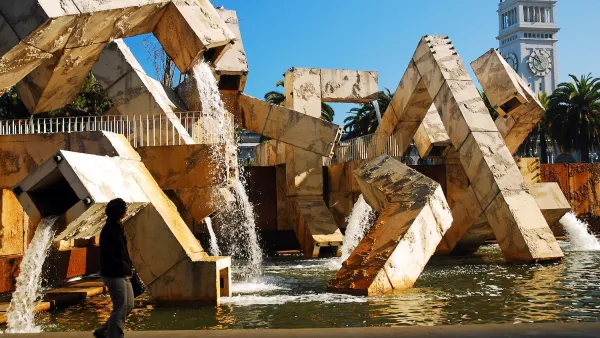
San Francisco to Dismantle its Polarizing Brutalist Fountain
The Vaillancourt Fountain stands as a symbol of the tension between the city’s past and future.
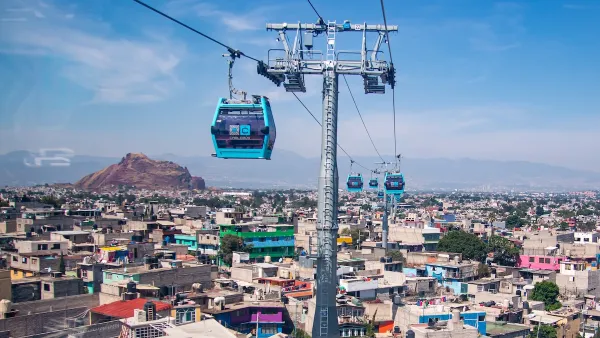
Mexico City Cable Cars Soar Above Gridlock
The Cablebús system transports more than 100,000 people each day and dramatically reduces commute times in the Mexican capital.

The state-sanctioned urbicide of Austin
People don’t kill cities. Freeways do.

US to reduce Colorado River water deliveries to Mexico
A new Colorado Treaty amendment reduces Mexico’s Colorado River water allocation by 250,000 acre feet.

New Jersey’s second-largest city bans standalone data centers
Jersey City will continue to allow co-location facilities, such as those meant for research institutions that store their own data.

Amtrak not solely to blame for New Jersey commuter rail's unreliability, report finds
A new study from the Garden State Initiative found that NJ Transit’s budget grew 20% across a 4 year period, but reliability declined significantly over the same period.

EPA erases limits on planet-warming pollution from power plants
Under Monday’s plan, power plants would still have some limits on how much mercury, arsenic and other contaminants they can emit.

Phoenix announces new on-demand transit service, more frequent RAPID buses
Both new services will launch in October, and are part of Phoenix's Project Effective Access Solutions for Easing Congestion.

FREE Course: Walkable City 1: Why Walkability?
After describing his path towards focusing on walkability as the essence of good planning, Jeff Speck marches through his five principal reasons for making more walkable places.
Reinventing Malls: Planning Alchemy—Turning Gray Fields Into Gold
The course focuses on the opportunities and imperatives that shape reinvention of mall sites.

Eagle County Government
Harvard University Graduate School of Design
Nashville Planning Department
The Architects Foundation
University of Cincinnati Online
The Pocatello Development Authority
The Urban Renewal Agency of the City of Pocatello
Journal of the American Planning Association