Following reports that Black Americans owned homes in 2017 than in 1983, banker Teri Williams offers recommendations to diversify homeownership across the United States.


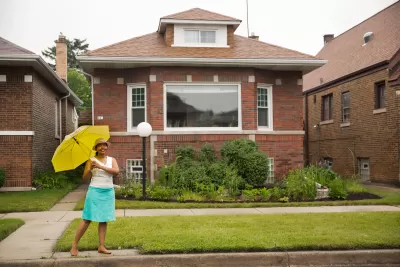
The gap in homeownership between black and white Americans is greater than it was in 1983, according to the "State of the Nation's Housing 2018" report from the Joint Center for the Study of Housing of Harvard University; just 43 percent of Black Americans owned homes in 2017, compared with 72 percent of whites. Teri Williams, a leader in the #BankBlack movement, lays out five strategies to combat the effects of the nation's racial wealth gap, shortage of affordable housing, and historically racist housing and banking policy.
One notable suggestion is beefing up first-time homebuyer programs, not only by increasing funding, but also by offering up municipal property. Rather than auctioning property acquired through foreclosures to investors, "a better alternative to diversify neighborhoods, offset gentrification and support community values would be to deed these properties to Black residents, organizations that offer first-time homebuyer programs or local private developers that partner with these organizations," Williams writes. Another recommendation is awarding Community Reinvestment Act (CRA) credits to banks for every loan provided to a Black first-time homebuyer.
FULL STORY: Five Steps Toward Ending the Black Homeownership Crisis in the US

4 Reasons Home Ownership Won't Close the Racial Wealth Gap
Homeownership is often promoted as a way for low-income and minority families to build wealth. But it is those very families who assume the most risk in buying a house.

Making Homeownership Work Better
Programs that help households of color buy homes haven't made much of a dent in the racial wealth gap. But some strategies could generate better outcomes for buyers.
Increased Homeownership Won’t Close the Racial Wealth Gap
Despite the hopes pinned on it, homeownership is still too affected by institutionalized racism at every turn to be an equalizer.

Planetizen Federal Action Tracker
A weekly monitor of how Trump’s orders and actions are impacting planners and planning in America.

The state-sanctioned urbicide of Austin
People don’t kill cities. Freeways do.

US to reduce Colorado River water deliveries to Mexico
A new Colorado Treaty amendment reduces Mexico’s Colorado River water allocation by 250,000 acre feet.

Guerilla urbanists are building DIY bus stop benches in Chicago
A before-and-after of one of the bus stops with a new bench. The new benches are not officially sanctioned or permitted, but the residents who placed them hope they will be the start of a network of DIY benches across the city.

Mamdani overhauls NYC's Vision Zero plan with 100 new policy goals
The overhaul aims to reduce traffic deaths and make streets safer for pedestrians, cyclists and drivers through lower speed limits, new safety infrastructure and more.

Amtrak not solely to blame for New Jersey commuter rail's unreliability, report finds
A new study from the Garden State Initiative found that NJ Transit’s budget grew 20% across a 4 year period, but reliability declined significantly over the same period.

FREE Course: Walkable City 1: Why Walkability?
After describing his path towards focusing on walkability as the essence of good planning, Jeff Speck marches through his five principal reasons for making more walkable places.
Reinventing Malls: Planning Alchemy—Turning Gray Fields Into Gold
The course focuses on the opportunities and imperatives that shape reinvention of mall sites.

Eagle County Government
Harvard University Graduate School of Design
Nashville Planning Department
The Architects Foundation
University of Cincinnati Online
The Pocatello Development Authority
The Urban Renewal Agency of the City of Pocatello
Journal of the American Planning Association